Did my bank text me a Zelle fraud alert?
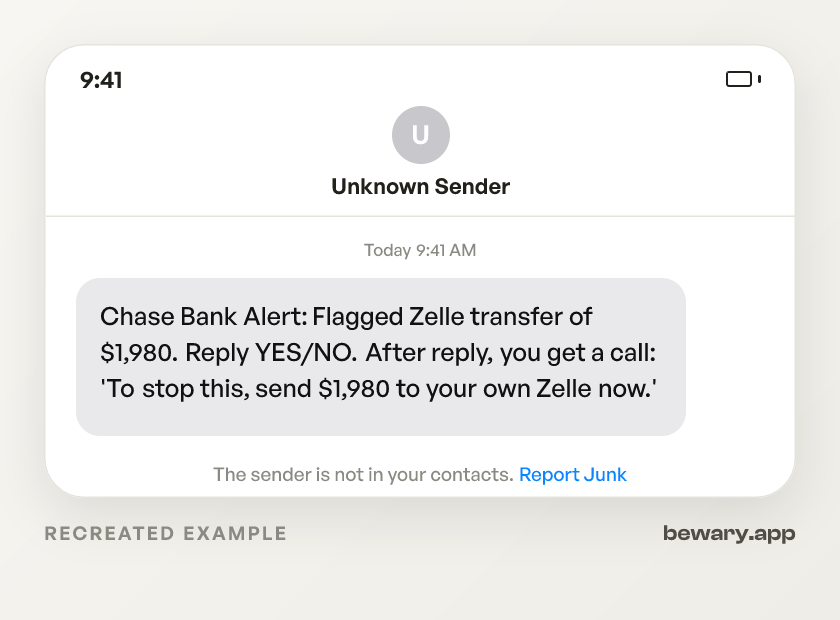
Chase Bank Alert: Flagged Zelle transfer of $1,980. Reply YES/NO. After reply, you get a call: 'To stop this, send $1,980 to your own Zelle now.'
The alert is bait and the call is the attack. The text exists only to make you reply, so that the call which follows is expected rather than suspicious. Then comes the instruction the whole thing was built around: send money to yourself with Zelle to cancel the fraud. There is no such mechanism. A Zelle payment sends money away from you, and "sending it to yourself" means sending it to a number the caller controls.
How to spot the Zelle scam
- You are told to send a Zelle payment to reverse or cancel one.Why
- The text wants a reply first, usually YES or NO. Either answer proves the number is live and hands the caller an opening: you have just told them you are paying attention.
- The call arrives within minutes of your reply, from the "fraud department".Why
- You are asked to move money to a "safe", "protected" or "holding" account.Why
- They ask for your online banking password, or trigger a password-reset text and ask you to read the code back.Why
- The transfer they describe is one you cannot place, for an amount just large enough to frighten you into acting before checking.
- You are kept on the line while you do it, and discouraged from ringing the bank separately.Why
What to do now
- Do not reply to the text, and hang up on the call.Why
- Never send a Zelle payment to cancel a Zelle payment, whoever asks and however urgent it sounds.
- Check the account in the bank's own app, opened from your home screen.Why
- Report it to your bank or credit union first, not to Zelle.Why
- Zelle's own support line is 1-844-428-8542, open 8am to 10pm ET, seven days a week.
- Write down the exact times, the calling number and what you were told, then file at ReportFraud.ftc.gov and ic3.gov.Why
What it looks like on your phone
Got a message like this? Check yours free
Paste any text, link, or number you are unsure about. Bewary gives you a straight answer in seconds, and the exact reason why.
Private. Never sold, never tied to you.
The detail behind this
The reasoning behind each line above, for when the immediate question is settled.
Why each of those gives it away
You are told to send a Zelle payment to reverse or cancel one.
Payments do not undo payments. This single instruction is the scam, and nothing else about the call needs examining once you hear it.
The call arrives within minutes of your reply, from the "fraud department".
The timing is the point, and caller ID showing the bank proves nothing because it is trivially spoofed.
You are asked to move money to a "safe", "protected" or "holding" account.
Banks do not relocate your money to keep it safe; your account already is the safe account.
They ask for your online banking password, or trigger a password-reset text and ask you to read the code back.
The code is the reset. Reading it out hands over the account.
You are kept on the line while you do it, and discouraged from ringing the bank separately.
Isolation is deliberate.
Working through the steps
Do not reply to the text, and hang up on the call.
Then ring the bank yourself on the number printed on your card, which is the only number in this situation that you can trust.
Check the account in the bank's own app, opened from your home screen.
A genuine flagged transfer appears there.
Report it to your bank or credit union first, not to Zelle.
Zelle runs through them and they decide reimbursement. Zelle distinguishes fraud, an unauthorised payment, which typically qualifies, from a scam, where you were persuaded to send it, and says certain impostor scams also qualify.
Write down the exact times, the calling number and what you were told, then file at ReportFraud.ftc.gov and ic3.gov.
A disputed-transfer investigation runs on that record, and both agencies are where Zelle directs people.
Sources and reporting
Use official channels to confirm a suspicious request and report fraud.