Is the UPS text about a $1.95 delivery fee real?
UPS Alert: Delivery suspended. Your package cannot be delivered due to an unpaid redelivery fee of $1.95. Confirm your address and pay before 11:59 PM or it will be returned to sender. https://ups.com@track-redelivery.sbs/verify/1Z6A482019 For iPhone users, reply Y, then reopen this message and tap the link to continue.
It is a scam. UPS says it never requests payment or personal information through unsolicited text messages. That settles it before you grade the logo or the spelling. The structural tell is the surprise SMS checkout, a tiny delivery or redelivery fee, and a link that moves you away from UPS into a card-harvesting page.
How to spot the UPS scam
- The fee is framed as a delivery fix, not a normal UPS tracking event.Why
- The amount is tiny on purpose. $1.95, $2.00, or $3.00 feels cheaper than losing a package, so the victim stops thinking and starts typing.Why
- The link uses UPS where your eye starts reading, not where the browser goes.Why
- The root domain is the evidence.Why
- The reply-Y instruction is not a customer service step.Why
- The 1Z tracking number is bait unless it works on ups.com.Why
- The deadline is there to make you skip the check.Why
- The form asks for a fraud kit, not a redelivery.Why
- A missed UPS delivery usually leaves a trail this text does not have.Why
What to do now
- Do not reply Y, tap again, or answer the sender.Why
- Check the shipment from UPS directly.Why
- If you opened the link, read the address bar, then close it.Why
- If you typed card details, call the number on the back of the card or in your bank app now.Why
- If you entered a one-time bank code, say those exact words to the bank fraud team.Why
- If you typed a UPS password, change it at ups.com from a new browser tab.Why
- Report the message, then remove the trap.Why
What it looks like on your phone
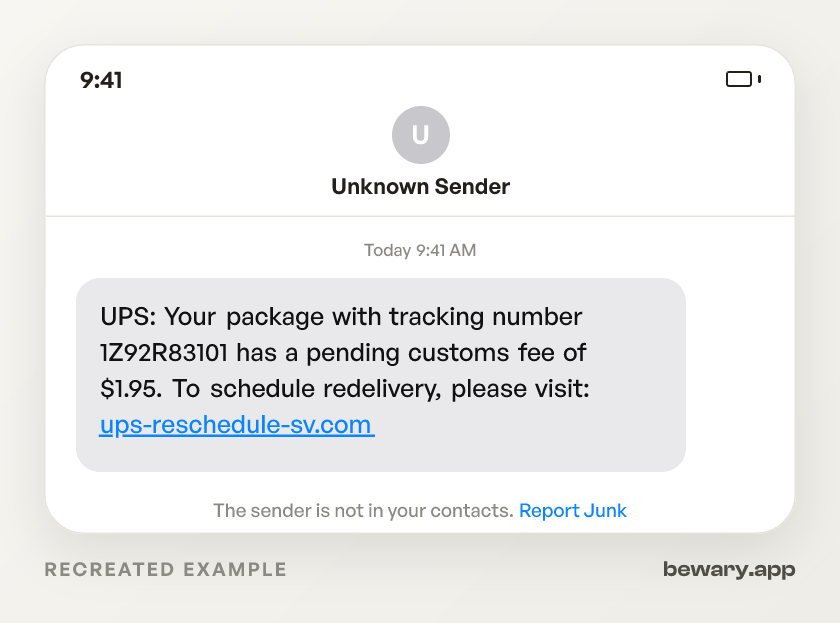
Got a message like this? Check yours free
Paste any text, link, or number you are unsure about. Bewary gives you a straight answer in seconds, and the exact reason why.
Private. Never sold, never tied to you.
The detail behind this
The reasoning behind each line above, for when the immediate question is settled.
Why each of those gives it away
The fee is framed as a delivery fix, not a normal UPS tracking event.
Real UPS tracking shows scans, locations, dates, and service messages tied to a shipment. This text skips that and jumps straight to a checkout page, because the card form is the whole job.
The amount is tiny on purpose. $1.95, $2.00, or $3.00 feels cheaper than losing a package, so the victim stops thinking and starts typing.
The scammer does not need that fee to clear. They need the card number, expiration date, CVV, billing ZIP, phone number, and any bank code that follows.
The link uses UPS where your eye starts reading, not where the browser goes.
In https://ups.com@track-redelivery.sbs, the real site is track-redelivery.sbs. The part before the @ is treated like login text. Scammers use it because people trust the first familiar word and miss the domain that actually loads.
The root domain is the evidence.
A page can copy the UPS shield, brown buttons, tracking boxes, and delivery language in an afternoon. It cannot make track-redelivery.sbs, ups-fee-help.top, or delivery-ups-pay.com become ups.com. Read the host from right to left, then stop at the real domain.
The reply-Y instruction is not a customer service step.
Some phones do not make a suspicious link tappable until you reply or interact, so the text tells iPhone users to reply Y and reopen the thread. That reply also marks your number as alive. Expect more delivery, toll, bank, and account-lock lures after that.
The 1Z tracking number is bait unless it works on ups.com.
Scammers paste a number starting with 1Z because many UPS tracking numbers look that way. Type ups.com yourself and search the number there. If UPS does not show the same package, same delivery problem, and same fee inside its own tracker, the SMS is decoration.
The deadline is there to make you skip the check.
Phrases like before 11:59 PM, final notice, delivery suspended, and returned to sender create a fake clock. A real delivery exception does not need you to trust a random text link. It can be checked from the UPS app, UPS My Choice, the merchant order page, or ups.com typed by hand.
The form asks for a fraud kit, not a redelivery.
Fake pages usually request full name, street address, email, mobile number, card number, expiration date, CVV, and billing ZIP. That bundle matches what online card checks ask for. If the page then asks for a one-time bank code, it may be trying to approve a transaction, add the card to a wallet, or reset access.
A missed UPS delivery usually leaves a trail this text does not have.
UPS can leave a UPS InfoNotice after a delivery attempt, and real tracking events show attempted delivery details. The scam message often has no InfoNotice number, no sender name, no service level, no scan city, and no package detail beyond a fake urgency line.
Working through the steps
Do not reply Y, tap again, or answer the sender.
That blocks the link-activation trick and avoids confirming your number as responsive. If you only opened the text, stop there.
Check the shipment from UPS directly.
Open the UPS app or type ups.com into your browser, then enter the 1Z number yourself. This separates a real UPS tracking event from a fake page built around copied branding.
If you opened the link, read the address bar, then close it.
In ups.com@track-redelivery.sbs, the site is track-redelivery.sbs. If you did not type anything, the scammer likely got a visit signal and device details, not your card.
If you typed card details, call the number on the back of the card or in your bank app now.
Say the card was entered on a fake UPS redelivery fee page. Ask for the card to be replaced and ask whether any pending wallet adds, online authorizations, or small test charges are showing.
If you entered a one-time bank code, say those exact words to the bank fraud team.
A code can approve more than a $1.95 charge. It can approve a wallet add, a password reset, or a higher transaction after the card details are already captured.
If you typed a UPS password, change it at ups.com from a new browser tab.
Use a password you do not use anywhere else. Then check UPS My Choice, saved addresses, delivery preferences, and recent profile changes, because a stolen account can redirect future packages.
Report the message, then remove the trap.
Forward the full text, including the link and sender, to fraud@ups.com. Then forward the SMS to 7726 so your mobile carrier receives the spam report. After both reports, delete the thread so the fake payment link is not sitting in your delivery texts.
Sources and reporting
Use official channels to confirm a suspicious request and report fraud.