Is this Apple Pay suspicious charge text real?
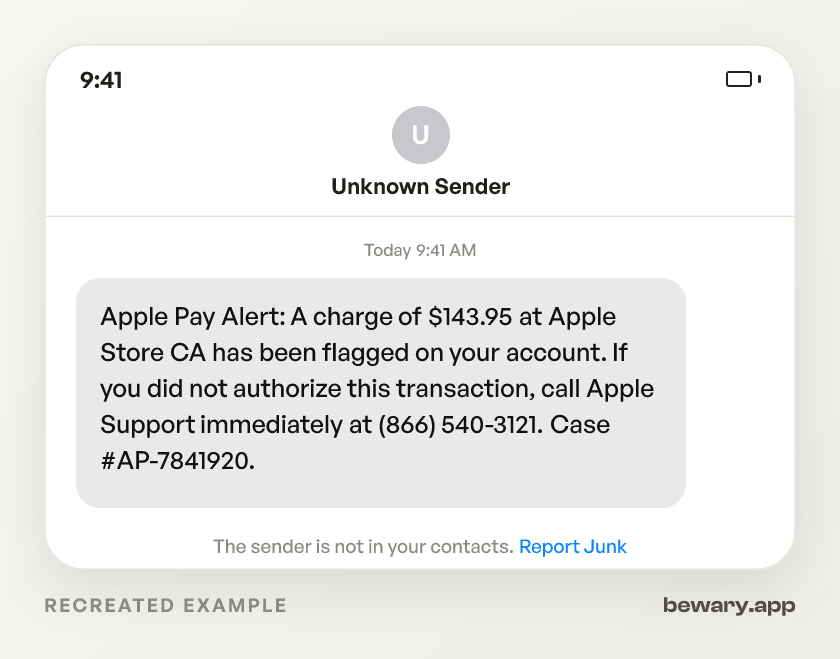
Apple Pay Alert: A charge of $143.95 at Apple Store CA has been flagged on your account. If you did not authorize this transaction, call Apple Support immediately at (866) 540-3121. Case #AP-7841920.
Scam. Delete it now. Apple Pay purchase alerts are push notifications from the Wallet app, not text messages. Apple's support site says it outright: they will never ask for your password or verification code by text or phone call. A real disputed charge is handled inside Wallet by tapping the transaction and choosing Report an Issue, or through your card issuer. No part of that process involves a phone number in a text.
How to spot the Apple scam
- Apple Pay sends purchase confirmations as push notifications through the Wallet app, not SMS.Why
- The text gives you a phone number to call.Why
- "Apple Store CA" is deliberately vague.Why
- The "Case #AP-7841920" is invented.Why
- Apple Pay never exposes your actual card number to merchants.Why
- If you call the number, the person on the line asks for your Apple ID email, password, and the six-digit code that pops up on your device.Why
- That six-digit code is not a confirmation receipt.Why
- Real Apple account notifications arrive as push notifications or emails from apple.com domains (such as appleid@id.apple.com), not SMS.Why
What to do now
- Do not call the number or tap any link.Why
- Open Wallet on your iPhone.Why
- If you gave your Apple ID password on the call, go to account.apple.com and change it now.Why
- If you read a six-digit code to the caller, assume your Apple ID was accessed.Why
- If you read your physical card number to the caller, phone your bank using the number on the back of that card.Why
- Forward the scam text to reportphishing@apple.com.Why
What it looks like on your phone
Got a message like this? Check yours free
Paste any text, link, or number you are unsure about. Bewary gives you a straight answer in seconds, and the exact reason why.
Private. Never sold, never tied to you.
The detail behind this
The reasoning behind each line above, for when the immediate question is settled.
Why each of those gives it away
Apple Pay sends purchase confirmations as push notifications through the Wallet app, not SMS.
That is built into how Apple Pay works at the system level. If you receive an SMS about an Apple Pay charge, the message did not originate from Apple's infrastructure.
The text gives you a phone number to call.
Apple's actual dispute path for Apple Pay: open Wallet, tap the transaction, choose Report an Issue. For Apple Card, you can message Apple Support directly inside the Wallet app. There is no scenario where Apple texts you a phone number for billing problems.
"Apple Store CA" is deliberately vague.
A real Wallet notification names the specific merchant and shows the last four digits of the card used. This text says "Apple Store CA" because the scammer does not know what you bought or which card you use with Apple Pay.
The "Case #AP-7841920" is invented.
Apple Support case IDs are created after you contact Apple through getsupport.apple.com or the Apple Support app. They never arrive in unsolicited messages. The scammer added it to make the text look procedural.
Apple Pay never exposes your actual card number to merchants.
It uses a device account number and transaction-specific dynamic security codes. The scammer has no Apple Pay data on you. This text is a cold lure blasted to thousands of phone numbers at once, hoping someone bites.
If you call the number, the person on the line asks for your Apple ID email, password, and the six-digit code that pops up on your device.
Apple's phishing guidance page warns that Apple will never ask for your password, device passcode, or two-factor authentication code by text or phone call. A real Apple advisor authenticates you through a support PIN displayed on your device, not by asking you to read your password.
That six-digit code is not a confirmation receipt.
It appears because the scammer is trying to log into your Apple ID at that moment, triggering Apple's trusted-device prompt on your phone. Read it aloud and the caller enters it before the code's 30-second window closes. Then your account is theirs.
Real Apple account notifications arrive as push notifications or emails from apple.com domains (such as appleid@id.apple.com), not SMS.
SMS sender names can be set to "Apple" by anyone for pennies through bulk gateways. The sender name on a text message is not proof of anything.
Working through the steps
Do not call the number or tap any link.
Close the message. If you already called, hang up. Nothing you said so far is as dangerous as what the caller will ask for next.
Open Wallet on your iPhone.
Tap each of your Apple Pay cards and scroll through recent transactions. If no $143.95 charge exists, the text was fiction. If a charge does appear, tap it and choose Report an Issue to dispute it through Apple's actual process.
If you gave your Apple ID password on the call, go to account.apple.com and change it now.
Check your trusted devices list and remove any you do not recognize. Review your recovery contacts and recovery key settings for changes you did not make.
If you read a six-digit code to the caller, assume your Apple ID was accessed.
Go to account.apple.com and check for added devices, changed payment methods, or unfamiliar purchases at reportaproblem.apple.com. Remove anything you did not authorize.
If you read your physical card number to the caller, phone your bank using the number on the back of that card.
Apple Pay itself uses tokenized card numbers, so the scammer only has your real card details if you gave them verbally. Your bank can freeze it and reissue.
Forward the scam text to reportphishing@apple.com.
Apple uses these reports to take down the phone numbers and domains involved. You can also forward the SMS to 7726 (SPAM) to flag it with your carrier.
Sources and reporting
Use official channels to confirm a suspicious request and report fraud.