Is this Apple Pay blocked charge text real?
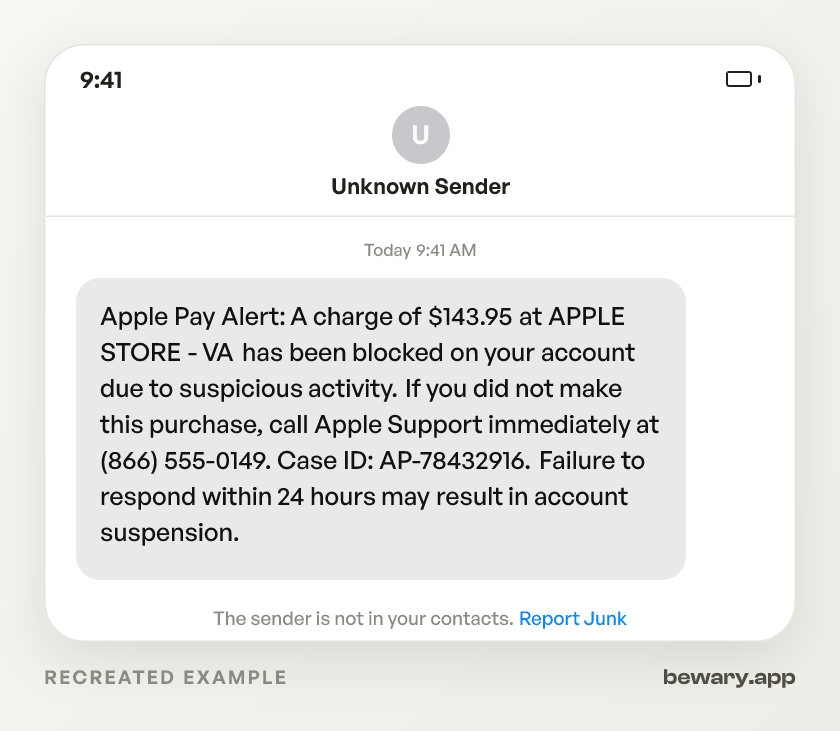
Apple Pay Alert: A charge of $143.95 at APPLE STORE - VA has been blocked on your account due to suspicious activity. If you did not make this purchase, call Apple Support immediately at (866) 555-0149. Case ID: AP-78432916. Failure to respond within 24 hours may result in account suspension.
Scam. Delete it. Apple does not text you about blocked charges, period. Their support page states: "Apple will never ask you to provide your password, device passcode, or two-factor authentication code or to enter it into any website." This text routes you to a live scammer who asks for your Apple ID login while typing it into your account on a second screen.
How to spot the Apple scam
- Apple does not text you to call a phone number.Why
- The dollar amount is picked to feel plausible. $143.95 sits in the range where you would worry but could not immediately rule it out.Why
- The callback number reaches a scammer's call center.Why
- The case ID ('AP-78432916') is fabricated.Why
- The 24-hour suspension threat has no teeth.Why
- Once you call, the person asks for your Apple ID password and the six-digit verification code Apple sends your phone.Why
- The sender name may display as 'Apple' or a five-digit short code.Why
What to do now
- Do not call the number.Why
- Open the Wallet app on your iPhone and look at your Apple Card or Apple Pay transaction history.Why
- If you already called and gave your Apple ID password or verification code, go to appleid.apple.com now.Why
- If you read a card number to the caller, phone that card's issuer from the number on the physical card.Why
- Forward the scam text to reportphishing@apple.com.Why
- If money left your account, file at reportfraud.ftc.gov and include the callback number from the text.Why
What it looks like on your phone
Got a message like this? Check yours free
Paste any text, link, or number you are unsure about. Bewary gives you a straight answer in seconds, and the exact reason why.
Private. Never sold, never tied to you.
The detail behind this
The reasoning behind each line above, for when the immediate question is settled.
Why each of those gives it away
Apple does not text you to call a phone number.
Real Apple Pay fraud alerts arrive as push notifications from the Wallet app or emails from apple.com addresses. Apple owns the device and pushes directly to it. SMS sits outside their entire fraud notification pipeline.
The dollar amount is picked to feel plausible. $143.95 sits in the range where you would worry but could not immediately rule it out.
Open your Wallet app and check Apple Card transactions. If the charge is not listed, it does not exist.
The callback number reaches a scammer's call center.
Apple Card support is available only through the Wallet app or the number printed on your physical Apple Card. Apple publishes no other card-dispute line. If a text hands you a ten-digit number, someone else answers it.
The case ID ('AP-78432916') is fabricated.
Apple does not assign case IDs by text for charge disputes. Search it on Apple's support site. Nothing returns, because it was typed into a bulk-SMS dashboard minutes before you received it.
The 24-hour suspension threat has no teeth.
Apple Card fraud protection works automatically: a blocked charge stays blocked with no action from you. Apple does not suspend accounts because you ignored a text, and no legitimate fraud system runs on a countdown timer tied to a single SMS.
Once you call, the person asks for your Apple ID password and the six-digit verification code Apple sends your phone.
That code is a live login token. While you read it out, they enter it at appleid.apple.com. Within seconds they control your account, your iCloud data, and every payment method stored in it.
The sender name may display as 'Apple' or a five-digit short code.
SMS sender IDs are chosen by the sender, not verified by your carrier. A $20 Twilio account can push texts labeled 'Apple' to thousands of numbers in minutes. The display name proves nothing about origin.
Working through the steps
Do not call the number.
Close the message. That number connects to the scam operation, not to Apple.
Open the Wallet app on your iPhone and look at your Apple Card or Apple Pay transaction history.
No matching charge means no charge. The text was invented.
If you already called and gave your Apple ID password or verification code, go to appleid.apple.com now.
Change your password, check the trusted-devices list, and remove anything you do not own. The scammer may still be logged in on their machine.
If you read a card number to the caller, phone that card's issuer from the number on the physical card.
The scammer may already be running transactions against it. Freezing the card stops charges that have not yet cleared.
Forward the scam text to reportphishing@apple.com.
Apple uses these reports to get spoofed sender IDs and callback numbers taken down. Then delete the message.
If money left your account, file at reportfraud.ftc.gov and include the callback number from the text.
The FTC shares these numbers with carriers who can kill the line and with law enforcement building cases against the call center.
Sources and reporting
Use official channels to confirm a suspicious request and report fraud.