Someone sent me money on Zelle, Venmo, or Cash App by accident and wants it back. Is this a scam?
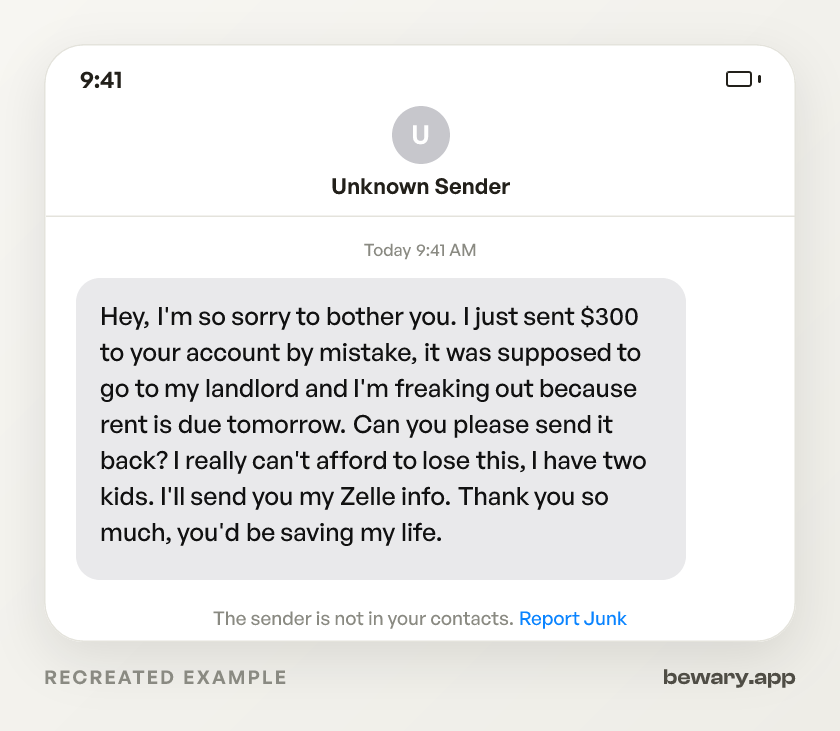
Hey, I'm so sorry to bother you. I just sent $300 to your account by mistake, it was supposed to go to my landlord and I'm freaking out because rent is due tomorrow. Can you please send it back? I really can't afford to lose this, I have two kids. I'll send you my Zelle info. Thank you so much, you'd be saving my life.
Yes, this is a scam. All three apps let senders reverse genuine mistakes through support. A real accidental sender would use that process, not message you begging for a refund. They skip it because the money came from a stolen bank account or credit card. Requesting a reversal would expose the fraud. They need you to send new, clean money from your own account instead.
How to spot this scam
- Zelle, Venmo, and Cash App each let senders reverse genuine mistakes through their own support process.Why
- The money came from a stolen source.Why
- You are asked to send money, not simply accept a reversal.Why
- The story is tailored to make refunding feel morally urgent.Why
- The contact comes outside the app.Why
- The amount is calibrated.Why
- None of the major apps reimburse you if you authorized the transfer.Why
- The scammer may show you a screenshot of the 'accident.'Why
What to do now
What it looks like on your phone
Got a message like this? Check yours free
Paste any text, link, or number you are unsure about. Bewary gives you a straight answer in seconds, and the exact reason why.
Private. Never sold, never tied to you.
The detail behind this
The reasoning behind each line above, for when the immediate question is settled.
Why each of those gives it away
Zelle, Venmo, and Cash App each let senders reverse genuine mistakes through their own support process.
If the person contacting you won't use it, the payment can't survive a formal review. That alone settles it.
The money came from a stolen source.
The deposit in your account was funded by someone else's compromised bank account or credit card. When the real owner notices, the bank claws it back. Your balance drops by the original amount, but the 'refund' you sent is already gone.
You are asked to send money, not simply accept a reversal.
A legitimate mistake requires zero action from you. The moment someone asks you to initiate a new outbound payment, you are not undoing a mistake. You are giving a stranger your money.
The story is tailored to make refunding feel morally urgent.
Rent due tomorrow, kids to feed, a paycheck they can't lose. This scam has a specific clock. The scammer needs you to send money before the stolen deposit gets flagged and reversed by the bank. Every hour you wait is an hour closer to the fraud surfacing.
The contact comes outside the app.
A text, a DM, sometimes a voicemail. The apps' own dispute flows don't require the recipient to do anything. Out-of-band contact is the workaround for a process the scammer can't use.
The amount is calibrated.
Large enough to profit from, small enough that you might send it back without calling your bank first. That sweet spot is the entire design of the scam.
None of the major apps reimburse you if you authorized the transfer.
Once you hit send, the money is gone. Zelle, Venmo, and Cash App all distinguish between unauthorized fraud (someone broke into your account) and authorized transfers (you sent it yourself). This scam is engineered so your refund counts as authorized.
The scammer may show you a screenshot of the 'accident.'
Screenshots are trivially faked. The deposit in your account is real, but that doesn't make it legitimate. Fraudulent deposits look identical to real ones until the chargeback hits.
Working through the steps
Do not send any money back.
This is the only step that matters. The moment you send a new payment, those funds belong to the scammer and no app will reverse an authorized transfer.
Call your bank or credit union directly.
Use the number on the back of your debit card, not any number from the message. Tell them you received an unsolicited deposit you believe is fraudulent. They can flag the transaction and freeze the funds before the reversal hits your balance.
Report the payment inside the app.
Tap the suspicious transaction in your history and flag it as fraud. All three apps route transaction-level reports to their fraud teams, which is how they trace the stolen bank account that funded the deposit.
Block the sender in the app and on your phone.
This scam has a second act. If you don't pay right away, the messages get more desperate, sometimes threatening. Blocking kills the pressure campaign before it escalates.
File a complaint at ReportFraud.ftc.gov.
Pick 'scams and rip-offs,' name the app, and paste the sender's username or phone number. The FTC can't recover your money, but these reports build the federal cases that shut down fraud rings running stolen-account operations at scale.
Leave the deposited funds alone.
Do not spend them. Your bank will reverse the fraudulent deposit once the real account holder disputes it. If the money is still there, the reversal is clean. If you spent it, you owe your bank the difference.
Sources and reporting
Use official channels to confirm a suspicious request and report fraud.