Is the person I met online a scammer?
Hey! I know this is random but I think I accidentally texted the wrong number lol. But you seem really cool 😊 I'm Sarah, just moved here from Vancouver for work. What part of town are you in? Maybe it was fate haha
If they dodge every video call, yes. That refusal is the tell that settles it before anything else. Broken camera one week, military deployment the next, hospital the week after. One excuse is normal. A rotating set over weeks means the face in the photos is someone else's. The FTC recorded $1.3 billion in romance-scam losses in 2022.
How to spot this scam
- They found you out of nowhere.Why
- They refuse video calls, and the excuse changes every time.Why
- The relationship moves absurdly fast.Why
- They can never meet in person.Why
- They ask for money in forms you can't claw back.Why
- They steer you toward a 'sure thing' investment.Why
- Their story has seams.Why
- They isolate you from skeptics.Why
What to do now
- Stop sending money right now.Why
- Reverse-image search their photos.Why
- Demand a live video call with a specific, spontaneous gesture.Why
- Report the profile on the platform where you met them.Why
- File a report at ReportFraud.ftc.gov.Why
- File a second report at ic3.gov, the FBI's fraud complaint center.Why
What it looks like on your phone
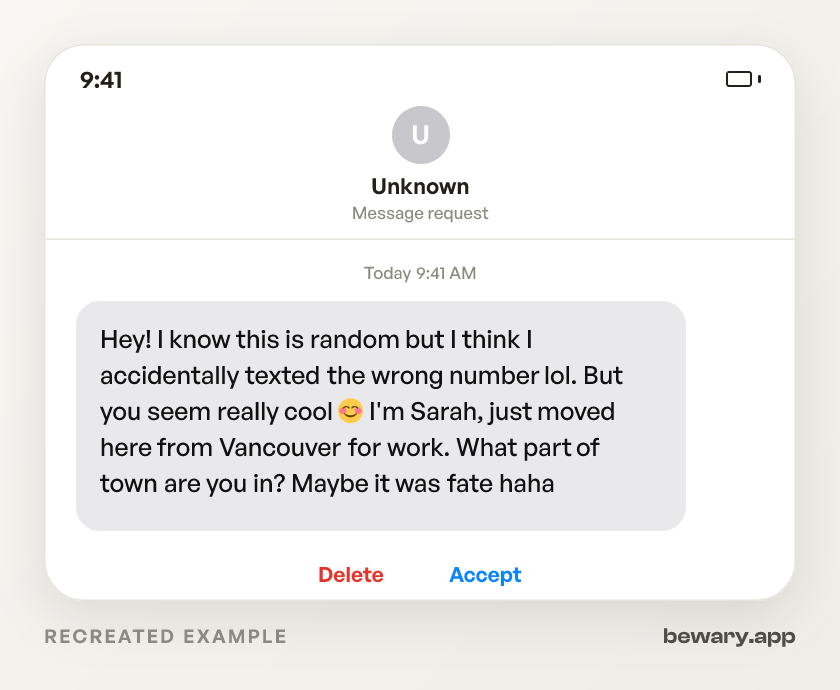
Got a message like this? Check yours free
Paste any text, link, or number you are unsure about. Bewary gives you a straight answer in seconds, and the exact reason why.
Private. Never sold, never tied to you.
The detail behind this
The reasoning behind each line above, for when the immediate question is settled.
Why each of those gives it away
They found you out of nowhere.
A 'wrong number' text, a cold DM, a dating-app match who escalates fast. The contact feels like a happy accident because it's scripted to. Real accidents don't lead to daily love letters within a week.
They refuse video calls, and the excuse changes every time.
Broken camera, then bad Wi-Fi, then deployed overseas. One canceled call is life. Four in a row with four different reasons means the person behind the keyboard doesn't match the photos. Run those photos through images.google.com. AI-generated faces often have mismatched earrings, blurred teeth, or a background that warps near the hairline.
The relationship moves absurdly fast.
'I've never felt this way before' on day three. Professionals call it love-bombing. The point is to get you emotionally committed before the money request lands. Nobody who has only read your texts for 72 hours is in love with you.
They can never meet in person.
A flight gets canceled, a family emergency hits, a work trip extends. Every proposed meetup collapses because meeting you in person would end the con. The relationship stays text-only by design.
They ask for money in forms you can't claw back.
Wire transfers, gift cards, cryptocurrency. No real partner asks you to buy Steam cards to cover a hospital bill. Scammers pick these methods because once the money moves, your bank cannot reverse it and law enforcement cannot trace it.
They steer you toward a 'sure thing' investment.
This is the pig-butchering variant. They hand you a link to a crypto platform or forex app. You deposit real money, the dashboard shows 40% gains, and when you try to withdraw, the site demands a 'tax fee' first. The platform is a shell. The gains are pixels on a screen, not money in an account.
Their story has seams.
They claim to be American but spell 'colour' with a u. They say they're a surgeon but can't name their hospital. They're online at 3 AM your time every single night. These operations run in shifts across time zones, and the persona doesn't always keep its details straight.
They isolate you from skeptics.
'Don't tell your family, they won't understand what we have.' Anyone pushing you away from the people who know you best is protecting the scam, not the relationship.
Working through the steps
Stop sending money right now.
If you've already sent funds, call your bank or the gift-card issuer today. Wire transfers can sometimes be recalled within hours. Gift-card balances can sometimes be frozen if they haven't been redeemed yet.
Reverse-image search their photos.
Go to images.google.com and upload the profile picture. If it shows up on stock-photo sites or other accounts under different names, the person texting you didn't take it.
Demand a live video call with a specific, spontaneous gesture.
Ask them to hold up three fingers, or write today's date on paper and show it on camera. Pre-recorded video and basic deepfakes can't handle a request they didn't anticipate. If they refuse, that is your answer.
Report the profile on the platform where you met them.
Dating apps and social networks let you flag fake accounts. Removing the profile cuts off the scammer's access to the next target.
File a report at ReportFraud.ftc.gov.
Include screenshots, usernames, phone numbers, wallet addresses, and transaction receipts. The FTC aggregates these to map scam networks. One complaint alone looks small. Hundreds pointing to the same wallet address trigger an enforcement case.
File a second report at ic3.gov, the FBI's fraud complaint center.
IC3 shares data across federal and international agencies. Your wallet addresses and phone numbers get cross-referenced against other victims' reports, and that overlap is how investigators identify and shut down the operations.
Sources and reporting
Use official channels to confirm a suspicious request and report fraud.