Is the person I met online a romance scammer using deepfakes?
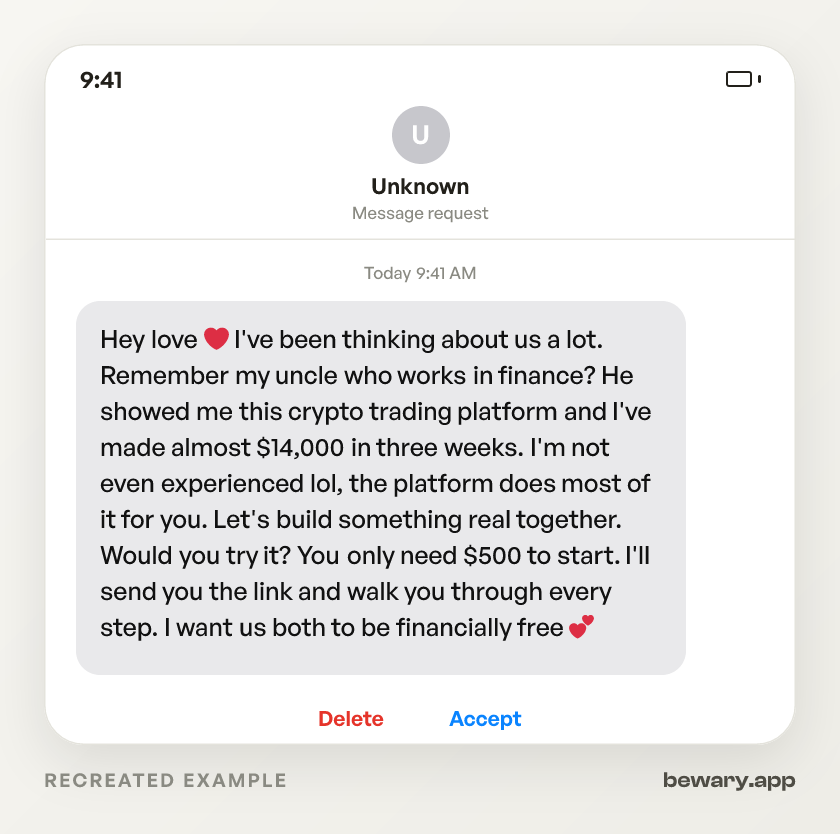
Hey love ❤️ I've been thinking about us a lot. Remember my uncle who works in finance? He showed me this crypto trading platform and I've made almost $14,000 in three weeks. I'm not even experienced lol, the platform does most of it for you. Let's build something real together. Would you try it? You only need $500 to start. I'll send you the link and walk you through every step. I want us both to be financially free 💕
Yes, this is a romance scam. The tell that settles it: no real partner asks you to deposit money into a specific crypto trading platform they recommended. That platform is fake, built and controlled by the same fraud network that created the dating profile. It displays fabricated gains to keep you depositing, then blocks withdrawals behind invented fees. The UN Office on Drugs and Crime has documented Southeast Asian scam compounds using real-time deepfake face-swapping on video calls, so the common advice to 'video chat them to be sure' no longer works.
How to spot this scam
- They push a specific crypto platform you cannot find anywhere official.Why
- The platform dashboard shows only gains.Why
- Withdrawals trigger demands for more money.Why
- They moved you off the dating app within the first few messages.Why
- Every payment method they accept is irreversible.Why
- A reverse image search on their photos returns nothing.Why
- Multiple operators share the same identity.Why
- Video calls are short, tightly framed, and always initiated by them.Why
What to do now
- Stop all payments immediately.Why
- Do not tell the scammer you suspect fraud.Why
- Preserve every piece of evidence before anything disappears.Why
- Report the profile on the dating app where you matched.Why
- File a complaint at the FBI's IC3 (ic3.gov) and include every wallet address and the fake platform's URL.Why
- Report to the FTC at ReportFraud.ftc.gov.Why
What it looks like on your phone
Got a message like this? Check yours free
Paste any text, link, or number you are unsure about. Bewary gives you a straight answer in seconds, and the exact reason why.
Private. Never sold, never tied to you.
The detail behind this
The reasoning behind each line above, for when the immediate question is settled.
Why each of those gives it away
They push a specific crypto platform you cannot find anywhere official.
Search the name on the CFTC's RED List (cftc.gov/LearnAndProtect) and FinCEN's MSB registrant search. It will not appear. Run a WHOIS lookup on the domain. Pig-butchering platforms are typically registered weeks before the scam begins, through privacy-shielded registrars, with no corporate entity behind them.
The platform dashboard shows only gains.
Real markets crash. Real portfolios have red days. The numbers on your screen are not connected to any trading engine. When the DOJ has seized pig-butchering platform servers, investigators confirmed the displayed balances were editable database entries with no connection to any blockchain or exchange.
Withdrawals trigger demands for more money.
The platform invents a 'tax clearance fee,' 'insurance deposit,' or 'anti-money-laundering verification payment.' Each fee leads to another. This is the extraction loop that turns a $500 deposit into a $50,000 loss. No brokerage or exchange anywhere requires you to send additional crypto before releasing your own holdings.
They moved you off the dating app within the first few messages.
Dating platforms run keyword filters that flag terms like 'crypto,' 'invest,' and 'trading platform.' Once the conversation shifts to WhatsApp or Telegram, those filters cannot reach it. The dating profile is disposable. Your private-channel chat history is the real operation.
Every payment method they accept is irreversible.
Crypto to a wallet address, wire transfer, gift card codes read over the phone. They will never accept a credit card or PayPal, because both allow chargebacks. That pattern is the fraud signal. A real person in your life does not structure every single transaction to be unrecoverable.
A reverse image search on their photos returns nothing.
Try Google Images, TinEye, and PimEyes. Faces generated by tools like Stable Diffusion or Midjourney have no history anywhere on the internet. A real person's face appears in tagged social posts, employer directories, event galleries. A generated face exists only in the profiles the scammer planted.
Multiple operators share the same identity.
Pig-butchering rings run from compounds with dozens of workers rotating shifts on each 'person.' That is why the tone of messages shifts between warm and flat, why grammar quality changes between exchanges, and why they sometimes forget details you already told them. You are not talking to one person. You are talking to a desk.
Video calls are short, tightly framed, and always initiated by them.
Deepfake face-swap software maps one face onto another in real time, but it breaks on sudden head turns, partial face occlusion, and uneven lighting. Ask them to hold up a specific object you name. Ask them to turn in profile. Ask them to wave with both hands near their face. If they dodge every request, the face on screen may be a real-time swap running over someone else's camera feed.
Working through the steps
Stop all payments immediately.
Every dollar goes directly into the fraud network's wallet. The platform balance is a number in their database, not money you can recover by depositing more. The 'tax' they are asking for will be followed by another fee, then another. Cut the loop now.
Do not tell the scammer you suspect fraud.
These operations routinely pivot to sextortion when a target pulls away, threatening to send intimate photos or chat logs to your contacts list. Keep communicating normally or go silent, but do not announce your next move.
Preserve every piece of evidence before anything disappears.
Export your full chat history from WhatsApp or Telegram. Screenshot every transaction confirmation, wallet address, platform URL, deposit history page, and phone number. Investigators reconstruct the money trail from these records, and fund-recovery actions fail without them.
Report the profile on the dating app where you matched.
Tinder, Bumble, and Hinge each have in-app fraud reporting that feeds their detection models. Your report trains the filter to catch the next profile this network spins up with the same photo set or device fingerprint.
File a complaint at the FBI's IC3 (ic3.gov) and include every wallet address and the fake platform's URL.
IC3 runs the Recovery Asset Team, which works with banks to freeze fraudulent wire transfers. The FBI's 2023 Internet Crime Report states the RAT froze over $538 million in fraudulent transfers that year. Speed matters.
Report to the FTC at ReportFraud.ftc.gov.
The FTC feeds complaints into its Consumer Sentinel Network, which, per the FTC's own published figures, over 2,800 law enforcement agencies access to identify fraud rings. Your single report becomes part of the pattern that connects this operation to others across the country.
Sources and reporting
Use official channels to confirm a suspicious request and report fraud.