Is this IRS phone call about back taxes real?
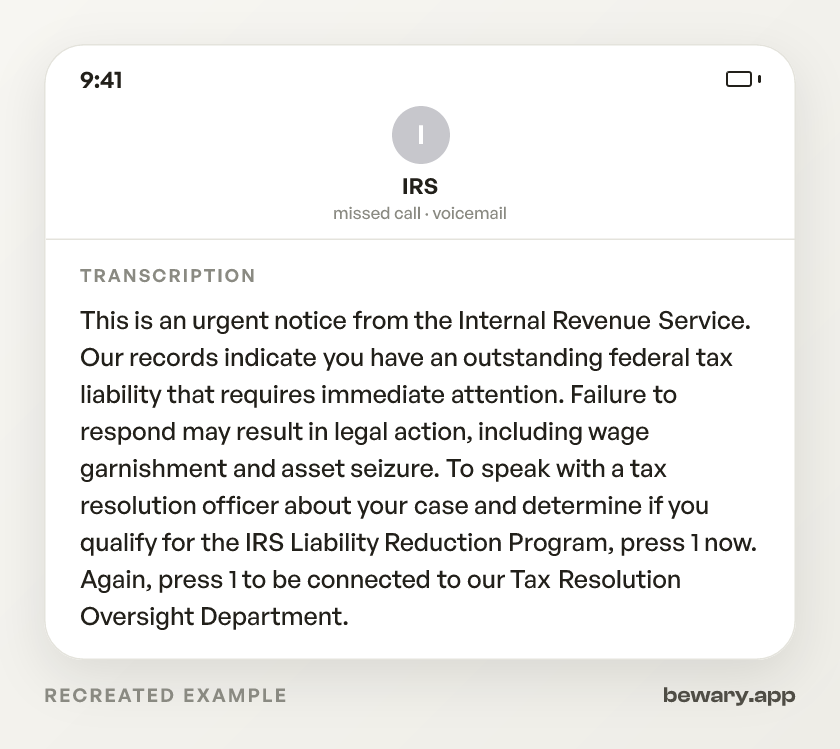
This is an urgent notice from the Internal Revenue Service. Our records indicate you have an outstanding federal tax liability that requires immediate attention. Failure to respond may result in legal action, including wage garnishment and asset seizure. To speak with a tax resolution officer about your case and determine if you qualify for the IRS Liability Reduction Program, press 1 now. Again, press 1 to be connected to our Tax Resolution Oversight Department.
Scam. The recording is selling a service that does not need selling, and it reaches you by a route the IRS does not use: the IRS contacts people by post first, and states it never calls to demand payment now, threaten arrest, or tell you about a refund. A robocall promising to settle your tax debt for pennies is an advance-fee operation wearing an official coat.
How to spot the IRS scam
- It is a recorded voice about tax debt, forgiveness, or a settlement programme you never enquired about.
- It claims a limited-time federal programme or an amnesty window.Why
- You are asked for an upfront fee to secure the settlement.Why
- It threatens arrest, deportation or licence loss if you do not act.Why
- It wants a prepaid debit card, gift card or wire transfer.Why
- There is no letter.Why
- They ask for your Social Security number or bank details to check eligibility.Why
What to do now
- Hang up and do not press any key, including the one offered to opt out.Why
- Check whether you actually owe anything at irs.gov, or by calling the IRS on a number you looked up yourself.
- Never pay an upfront fee for tax-debt help on an inbound call.Why
- Report the impersonation to TIGTA on 800-366-4484 or through its IRS Impersonation Scam Reporting form.
- Send the number and details to phishing@irs.gov with "IRS Phone Scam" in the subject line, which is the format the IRS asks for.
- If you already paid a fee, contact your bank or card issuer immediately and report it at ReportFraud.ftc.gov.
What it looks like on your phone
Got a message like this? Check yours free
Paste any text, link, or number you are unsure about. Bewary gives you a straight answer in seconds, and the exact reason why.
Private. Never sold, never tied to you.
The detail behind this
The reasoning behind each line above, for when the immediate question is settled.
Why each of those gives it away
It claims a limited-time federal programme or an amnesty window.
Genuine IRS collection alternatives are not sold by robocall on a deadline.
You are asked for an upfront fee to secure the settlement.
That fee is the entire business model, and the settlement never materialises.
It threatens arrest, deportation or licence loss if you do not act.
The IRS says it never calls to threaten arrest.
It wants a prepaid debit card, gift card or wire transfer.
The IRS names exactly those as methods it will never demand.
There is no letter.
The IRS makes first contact by post, so a debt that exists only on the phone does not exist.
They ask for your Social Security number or bank details to check eligibility.
The IRS already holds your file.
Working through the steps
Hang up and do not press any key, including the one offered to opt out.
A response marks the number as live.
Never pay an upfront fee for tax-debt help on an inbound call.
Genuine payment plans and offers in compromise are applied for directly with the IRS.
Sources and reporting
Use official channels to confirm a suspicious request and report fraud.