Is this Apple Pay charge text real?
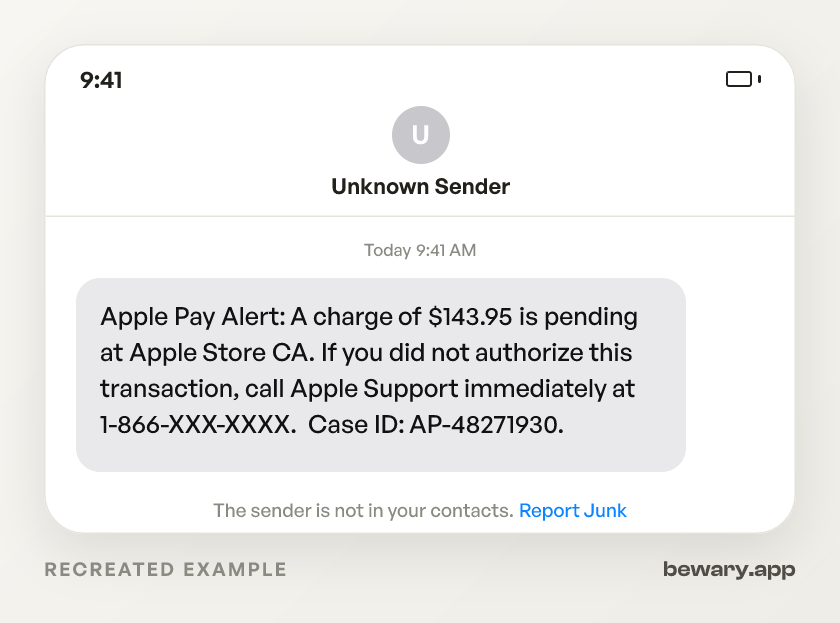
Apple Pay Alert: A charge of $143.95 is pending at Apple Store CA. If you did not authorize this transaction, call Apple Support immediately at 1-866-XXX-XXXX. Case ID: AP-48271930.
Scam. Not from Apple. Apple Pay has no SMS alert system, not a limited one, none at all. Transaction alerts are push notifications inside the Wallet app, tied to your device through Apple's encrypted push service. The callback number connects to a scammer who triggers a real Apple ID password reset on their end, then asks you to read back "the verification code Apple just sent." That code is the reset confirmation. You read it out, they own your account.
How to spot the Apple scam
- Apple Pay has no SMS notification channel.Why
- The text says the charge is "pending."Why
- "Apple Store CA" is not how your Wallet labels purchases.Why
- The callback number connects to a live person who triggers a real Apple ID password reset while you are on the line.Why
- Apple states: "Apple will never ask you to provide your Apple ID password, two-factor authentication codes, or device passcode over the phone or by text."Why
- The "Case ID" format (AP-48271930) mimics Apple's real support ticket numbering.Why
- The entire play depends on keeping you away from the Wallet app.Why
What to do now
- Open the Wallet app on your iPhone.Why
- If you called and gave your Apple ID password, go to appleid.apple.com now and change it.Why
- If you read a two-factor code to the caller, they may already control your Apple ID.Why
- If you gave a card number, call your bank at the number printed on the physical card.Why
- Forward the text to reportphishing@apple.com with a screenshot.Why
- Forward the text to 7726 (SPAM) so your carrier can block the sender's number.Why
What it looks like on your phone
Got a message like this? Check yours free
Paste any text, link, or number you are unsure about. Bewary gives you a straight answer in seconds, and the exact reason why.
Private. Never sold, never tied to you.
The detail behind this
The reasoning behind each line above, for when the immediate question is settled.
Why each of those gives it away
Apple Pay has no SMS notification channel.
Not a scaled-back one, not a fallback. Zero. Every transaction alert is a push notification delivered through Apple's encrypted push service to a specific device registered to your Apple ID. A text message about an Apple Pay charge is proof by itself that the sender is not Apple.
The text says the charge is "pending."
Apple Pay transactions settle instantly at the point of sale using a device-specific token number. There is no pending state you would ever be notified about. The word "pending" is borrowed from bank fraud alerts, where it actually means something. Apple Pay does not work that way.
"Apple Store CA" is not how your Wallet labels purchases.
Real Apple Store entries show the full store name with the city, like "Apple Union Square" or "Apple The Grove." The vague label tells you the sender has never seen what a real Wallet transaction entry looks like.
The callback number connects to a live person who triggers a real Apple ID password reset while you are on the line.
They say "read back the code Apple just sent for verification." That six-digit code is the password reset confirmation. You read it out, they type it in, and they are logged into your Apple ID before you hang up.
Apple states: "Apple will never ask you to provide your Apple ID password, two-factor authentication codes, or device passcode over the phone or by text."
The person on the callback line asks for exactly these, in sequence, usually starting with your Apple ID email to initiate the password reset on their device. Every ask violates Apple's published rule.
The "Case ID" format (AP-48271930) mimics Apple's real support ticket numbering.
But Apple assigns case IDs only during support sessions you initiate yourself through apple.com/contact or the Apple Support app. Go to getsupport.apple.com and search for that case number. It does not exist.
The entire play depends on keeping you away from the Wallet app.
One tap on Wallet shows every real charge on your card. No $143.95 from any merchant? Scam over. The words "pending" and "immediately" exist to route you toward the phone call before you check the one screen that would kill the scam in five seconds.
Working through the steps
Open the Wallet app on your iPhone.
Tap the card the text mentions. Scroll through recent transactions. No matching charge means the text is fake and you can delete it.
If you called and gave your Apple ID password, go to appleid.apple.com now and change it.
Then check Settings > [your name] > Devices and remove anything you do not recognize.
If you read a two-factor code to the caller, they may already control your Apple ID.
If you can still log in, change the password and remove unknown devices. If you cannot log in, start account recovery at iforgot.apple.com.
If you gave a card number, call your bank at the number printed on the physical card.
Tell them the number was read to a scammer. They will freeze it and issue a replacement.
Forward the text to reportphishing@apple.com with a screenshot.
Apple uses these reports to burn the callback numbers the scam rotates through.
Forward the text to 7726 (SPAM) so your carrier can block the sender's number.
Then file a report at reportfraud.ftc.gov, which feeds the FTC's database tracking SMS fraud rings by source number.
Sources and reporting
Use official channels to confirm a suspicious request and report fraud.