Is this upcoming payment text alert real?
Bank Fraud Alert: An upcoming Apple Pay/Zelle payment of $349.99 is scheduled from checking acct ending 7024. If this was you, reply YES. If you did NOT authorize, reply NO. Ref #PAY-88431
Scam. The reply is the trap. A real payment alert sends you back to your own account, where the charge either exists or it does not. This text makes the decision happen inside a stray message thread, then uses your YES or NO to time the fake fraud call.
How to spot this scam
- The message asks for YES or NO. That is not account protection, it is lead sorting.Why
- The text makes you handle a payment alert in the text thread.Why
- The amount feels real, but it proves nothing.Why
- The last four digits are not proof.Why
- The call comes right after you reply.Why
- The fake agent asks for a code.Why
- The fix moves money instead of stopping money.Why
- Gift cards can appear after the bank script.Why
- The reference number is theater.Why
What to do now
- Do not reply.Why
- Open the bank or wallet app yourself and check the places money would appear.Why
- If you already replied, let the next call go.Why
- If you gave a one-time code, act now.Why
- If you sent money, call the bank or payment app the same day.Why
- If the caller pushed gift cards, keep everything.Why
- Forward the original text to 7726.Why
What it looks like on your phone
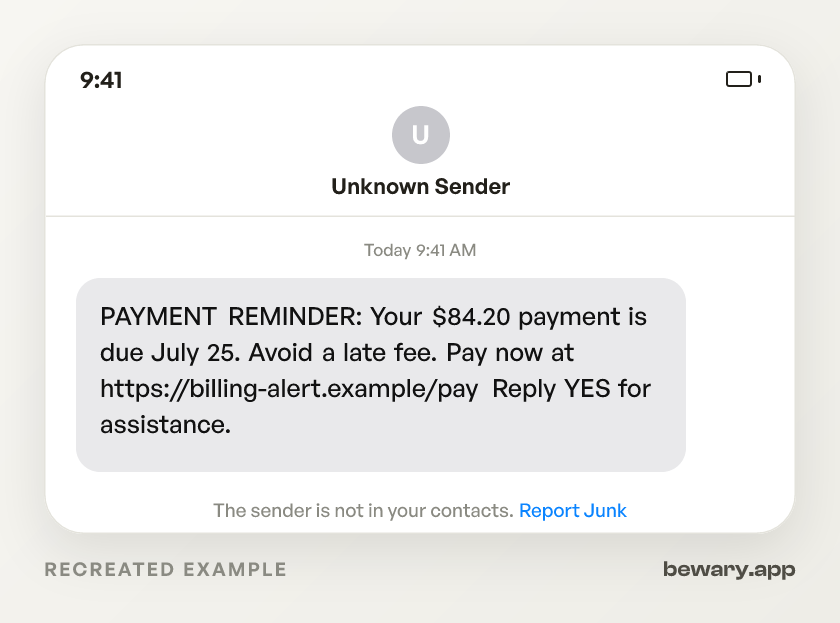
Got a message like this? Check yours free
Paste any text, link, or number you are unsure about. Bewary gives you a straight answer in seconds, and the exact reason why.
Private. Never sold, never tied to you.
The detail behind this
The reasoning behind each line above, for when the immediate question is settled.
Why each of those gives it away
The message asks for YES or NO. That is not account protection, it is lead sorting.
A scammer can blast the same text at a huge list, then call only the people who answered and proved they are worried, reachable, and holding the phone.
The text makes you handle a payment alert in the text thread.
Real alerts tell you to review activity in your account, not approve or reject a transfer by replying to an unknown sender. The scam needs the reply because it turns a cold text into a live setup for the next step.
The amount feels real, but it proves nothing.
A figure like $349.99 is chosen because it sounds like a phone, hotel hold, subscription renewal, or person-to-person payment. The scammer does not need account access to write a believable dollar amount. Your app is the test. If the payment is not in pending activity, scheduled payments, wallet activity, or Zelle history, the text has no backing.
The last four digits are not proof.
Some versions use checking digits, some use card digits, and some skip digits entirely. Four digits have only 10,000 possible combinations, and old receipts, breached records, mail, and random chance can make a match look personal. A match should make you check your account, not trust the sender.
The call comes right after you reply.
That timing is the pattern. Your answer tells the fraud crew that panic is fresh, so the fake fraud department calls before you slow down and open your app. Caller ID can be spoofed to show a bank name, a local number, or a familiar fraud label. The screen is not evidence.
The fake agent asks for a code.
That code is not a cancellation code, refund code, or case number. It is an authentication code triggered because the scammer is trying to log in, reset access, add a device, or enroll a payment recipient from their side. If you read it out, the bank system treats the code as approval.
The fix moves money instead of stopping money.
The caller tells you to reverse the pending payment by sending money to yourself, moving funds through Zelle, Apple Pay, Venmo, Cash App, or another wallet, or testing a transfer. That is the cash-out. You think you are blocking a fake payment. You are making a real one.
Gift cards can appear after the bank script.
When the caller fails to get a transfer, the story changes to a temporary hold, verification deposit, or emergency protection step. No fraud department cancels an electronic payment by sending you to buy gift cards, scratch PINs, and read the numbers. That turns your cash into something the scammer can drain fast.
The reference number is theater.
A string like Ref #PAY-88431 looks official because it has a prefix, a dash, and digits. Search your actual account for that reference, the amount, and the named payment rail. A real pending payment leaves a record in your account. A scam text only leaves a line in the message thread.
Working through the steps
Do not reply.
No YES, no NO, no STOP in that thread. Replying gives the scammer exactly what the text was built to collect: proof that the number is live and that a person is ready for a fraud call. Silence breaks the timing.
Open the bank or wallet app yourself and check the places money would appear.
Look at pending card charges, scheduled bill payments, Zelle activity, wallet transactions, and recent security alerts. This answers the real question without feeding the scam thread. If the $349.99, the recipient, or the reference number is absent, treat the text as fake.
If you already replied, let the next call go.
Do not argue with the caller and do not call back the number on the screen. Open your banking app and use the support link in the app, or use the number printed on your card. Say this plainly: you replied to a fake upcoming payment alert, and you need them to check for login attempts, new devices, password resets, and new payment recipients.
If you gave a one-time code, act now.
Tell the bank you disclosed an authentication code to an impersonator. Ask them to end active sessions, remove unfamiliar devices, reset online banking access, and review Zelle, wallet, and external-transfer enrollment. That cuts off the access the scammer was trying to approve with your code.
If you sent money, call the bank or payment app the same day.
Give the exact amount, time, recipient name, payment rail, and the caller ID that appeared. Ask for a recall, dispute, or fraud review. Person-to-person transfers settle quickly, so speed matters more than collecting perfect notes first.
If the caller pushed gift cards, keep everything.
Keep the cards, packaging, receipts, activation slips, and photos of the PINs. Call the issuer using the number printed on the card or receipt and ask whether the remaining balance can be frozen. This is tied to this scam because gift cards are the fallback cash-out when the fake agent cannot get a bank transfer or code.
Forward the original text to 7726.
Do not send a screenshot if your phone can forward the message itself. The original carries sender data and wording that carriers can use to cluster this YES/NO payment-alert campaign, not just one visible number. After forwarding, delete the thread so you do not answer it later by mistake.
Sources and reporting
Use official channels to confirm a suspicious request and report fraud.