Is the car warranty robocall a scam?
Yes, this is a scam: a real warranty company does not cold-call a “final notice” and ask for card details.
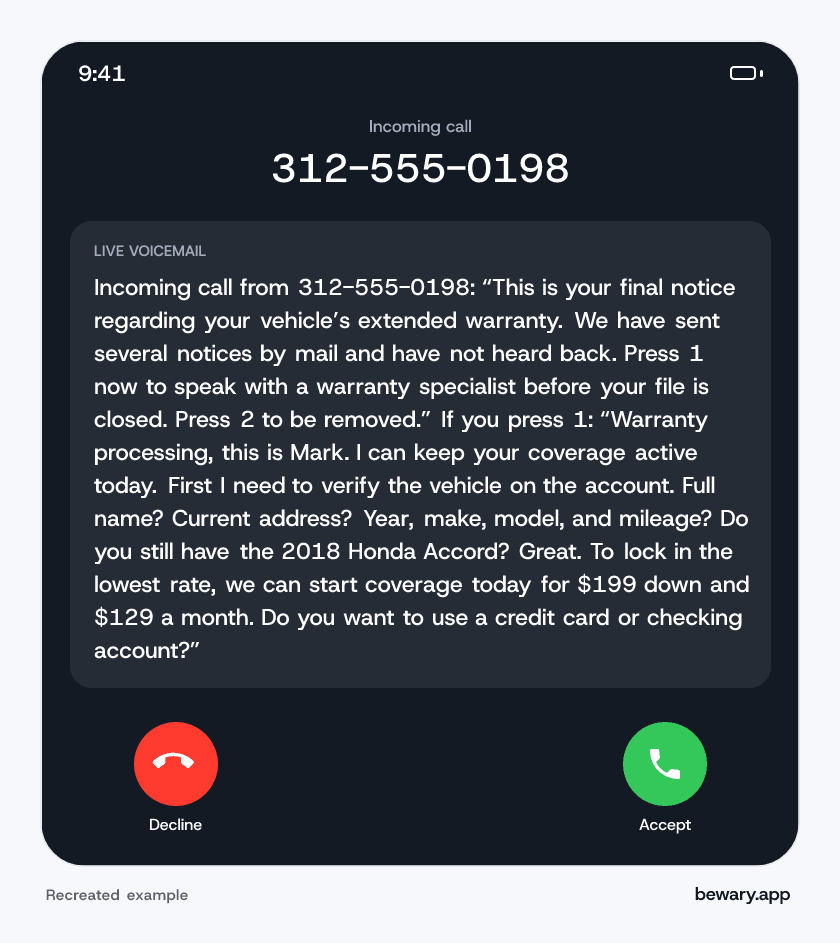
A cold warranty “final notice” that asks you to press 1, verify your car, or pay now is fake. Hang up.
What to do now
-
Hang up before pressing 1 or 2.
Pressing 1 sends you to the “warranty specialist” whose job is to pull your vehicle, mileage, and payment details. Pressing 2 may mark your number as answered, which is useful to the same dialer or the next one.
-
Check coverage in your own car papers, not through the caller.
Look for the sales folder, service-contract packet, dealer invoice, or warranty booklet that came with the vehicle. If you find a contract number, use that paper trail to see the term, mileage limit, administrator, and cancellation rules.
-
Call the dealer service desk only if your papers are unclear.
Ask whether your car still has factory coverage or a real service contract on file. Do not use the callback number from the robocall or voicemail, because that number leads back to the closer who started the fake “final notice.”
-
Dispute any down payment as a car-warranty telemarketing charge.
Search your card or bank activity for names like vehicle service, auto protection, VSC, warranty administration, or a small “processing” fee followed by a monthly charge. Tell the issuer it came from a cold warranty call, not a repair order you approved at a shop.
-
Cancel any emailed contract by its cancellation section, in writing.
Some callers send a real-looking service contract after the payment, then bill monthly while the cancellation clock runs. Use the cancellation method printed in that contract, keep a copy, and keep proof of when you sent it.
-
File an FCC unwanted-call complaint with the warranty script attached.
Include the caller ID, date, time, “final notice” wording, whether you pressed 1 or 2, the company name used, and the amount requested. Those details match the patterns regulators use to trace spoofed warranty traffic.
-
Silence unknown callers if you pressed a key or spoke to the closer.
Your number may get more warranty calls because the system now knows someone answered. Let those calls hit voicemail, then check only messages that name a real dealer, contract number, and vehicle you can match to your own papers.
How to spot this scam
Bewary's blocklist currently flags 16,373 phone numbers used in scam calls and texts. 14 of them are VoIP lines, the cheap numbers these campaigns burn through.
Bewary's own blocklist, as of November 26, 2026. This is what the list protects against, not a count of people targeted.
-
Hang up when a cold call says your car warranty is at final notice.
That exact line is the hook: “This is your final notice regarding your vehicle’s extended warranty.” It creates a fake deadline before you can check whether you have factory coverage, a service contract, or no warranty at all.
-
Do not trust the call because the number matches your area code.
Warranty robocalls spoof neighbor numbers, so a 312, 602, or 919 number can show up even when the dialer is nowhere near you. Caller ID shows the baited number, not the true caller.
-
Make the caller name the warranty company before you answer questions.
The script often says “your vehicle,” “your file,” or “warranty processing” instead of naming a contract administrator you can verify. Vague words let the caller sound tied to your dealer without proving any real account exists.
-
Refuse any “account lookup” that starts with your car details.
The closer asks for your name, address, year, make, model, mileage, or VIN because they do not have the account they claim to be protecting. A real warranty administrator already has the vehicle, contract term, and coverage dates tied to the contract number.
-
End the call when payment comes before a written contract.
The money move is the jump from “verification” to a down payment, often $199 today and a monthly draft after that. They want your card or checking account before you can read exclusions, cancellation terms, repair limits, or the real company name.
-
Ignore “we sent several notices” unless you can match the mail.
That line makes the call feel like the last step in a real paper trail. It also shifts blame to you, so you feel rushed to pay before your “file is closed.”
-
Do not press 2 to get removed from a warranty robocall.
Pressing a key can prove a live person answers that number, even if the voice says it will remove you. The next call may come from a fresh local-looking caller ID with a stronger closer.
-
Read the exclusions before you believe the cheap monthly quote.
Many of these calls sell vehicle service contracts, not a factory warranty, and the contract may skip the repair you thought it covered. The scam can be a bad sale, a data grab, or both.
-
Do not treat this as a harmless wrong-number call.
The FCC fined an auto-warranty robocall operation $299,997,000 after it made more than 5 billion calls to more than 500 million phone numbers in 2021. This is mass dialing built to find one person who will press 1 and pay.
Got a call like this? Check the number free
Enter the number that called. Bewary checks FTC and FCC complaints and its scam lists, and gives you a straight answer and the reason why.
Sources and reporting
Use official channels to confirm a suspicious request and report fraud.
- FCC Proposes Record $300 Million Fine for Auto Warranty Robocall Campaigncyberscoop.com
- FCC Cracks Down on Auto Warranty Robocall Scam – CBS Newscbsnews.com
- Car Warranty Scam Calls: How to Handle Them – Guard.ioguard.io
- FTC Action Leads to Industry Bans for Operators of Extended Vehicle Warranty Scamftc.gov