Is the Cardholder Services lower rate call a scam?
Yes, this is a scam: real card issuers do not robocall for full card details and a fee to lower your rate.
If the caller wants your full card number, CVV, SSN digits, or a fee before a rate cut, hang up. It is fake.
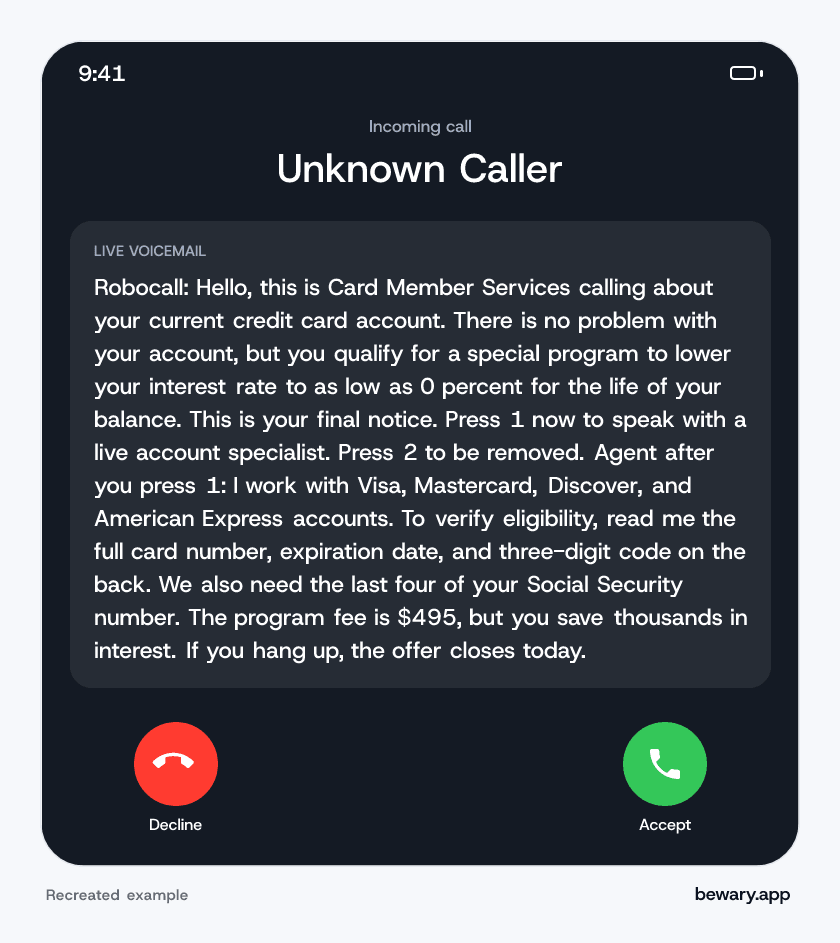
What to do now
-
Hang up while the agent is still talking.
These agents are closers, and they are trained to turn questions into more collection. If you ask them to prove they are real, they will often switch to a supervisor, a verification script, or a fake badge number, then steer you back to the card number and fee.
-
Do not press 2, press more keys, or call their callback number.
The remove-me option can mark your number as active, and a callback keeps you inside the same sales room. Leave the phone channel they started. Do not use any number the recording gave you.
-
Call your card issuer using the number on the back of your card.
Ask if a rate-reduction offer exists on your account and whether anyone has tried to access it. Also ask the agent to note that a third-party rate-cut caller may have your details, because that tells the bank what kind of fraud to watch for.
-
Lock or replace the card if you gave the number, expiration date, or CVV.
Use the bank app, your online account, or the number printed on the card. Ask the issuer whether any digital wallet tokens or saved-card updates need to be stopped too, because a card replacement may not kill every stored payment path by itself.
-
Change your bank login if they talked you through your account or a code.
Some rate-cut callers tell victims they need a one-time code or screen access to verify the APR. Tell the issuer if you read out a code, installed remote-access software, shared your screen, or let the caller watch you log in.
-
Dispute the fee if you paid the caller.
Tell the card issuer it was an advance-fee telemarketing pitch for credit card rate reduction. Give the amount, date, caller name, callback number, and merchant descriptor from the charge, because the billing name may not say Cardholder Services.
-
Report the call at ReportFraud.ftc.gov and unwanted calls at DoNotCall.gov.
Include the caller ID shown, any callback number, the exact rate promise, the fee amount, and whether they asked for the full card number, CVV, or SSN digits. If you have a voicemail or screenshot of the missed call, keep it until after you file.
How to spot this scam
Bewary's blocklist currently flags 16,373 phone numbers used in scam calls and texts. 14 of them are VoIP lines, the cheap numbers these campaigns burn through.
Bewary's own blocklist, as of November 26, 2026. This is what the list protects against, not a count of people targeted.
-
Hang up if the caller says Cardholder Services can cut every card rate.
The name sounds official, but it does not name your bank, your card, or your account. A real rate offer comes from the issuer that owns the account, not a floating service that claims it can change Visa, Mastercard, Discover, and American Express cards at once.
-
Hang up when the recording says to press 1 for a special rate.
That press-1 step sorts live targets from dead numbers and sends you to a closer. The closer already knows you stayed through a robocall, so the script moves fast: verify the card, read the security code, pay the program fee now.
-
Reject any caller who says they work with all major card networks.
Visa and Mastercard are payment networks, not your credit card lender. They do not set your APR on a Chase, Citi, Capital One, or credit union card, so a caller hiding behind network names is dodging the real issuer.
-
Refuse any caller who asks for your full card number and CVV.
The card number, expiration date, and three-digit code are enough to run card-not-present charges at many merchants. Your own issuer can find your account without asking you to read the security code from the back of the card during a surprise sales call.
-
Refuse any fee before the rate cut appears on your real account.
This pitch often calls the charge a processing fee, enrollment fee, or program fee, often around $395 or $495. The fee is the product. The promised lower APR does not have to exist for them to bill you.
-
Treat a lifetime 0 percent rate as bait.
The scam script promises a near-zero rate for the life of your balance but does not give the issuer name, offer ID, start date, end date, balance-transfer terms, or the account where the new APR will appear. Real card offers are tied to a specific account you can check before you accept.
-
Do not trust caller ID that matches your bank or your area code.
These calls often spoof bank service lines or a local number close to the billing ZIP on your account, then the agent says they are calling for your card company. The screen is part of the setup. It shows the number the caller chose to display, not proof they can change your APR.
-
End the call if they ask for the last four digits of your SSN.
Paired with your full card number, name, address, and phone number, those digits help the scammer get through bank phone checks or push an account-access reset. The risk is not vague identity theft. It is a stranger sounding more like you when they call your issuer.
-
Hang up when the agent says the offer expires today.
The deadline keeps you from opening your card app or calling the number on the back of the card. A real issuer does not need you to hand over a CVV and a $495 fee during one robocall to keep a lower APR offer alive.
Got a call like this? Check the number free
Enter the number that called. Bewary checks FTC and FCC complaints and its scam lists, and gives you a straight answer and the reason why.
Sources and reporting
Use official channels to confirm a suspicious request and report fraud.