Is this government or bank threat call a scam?
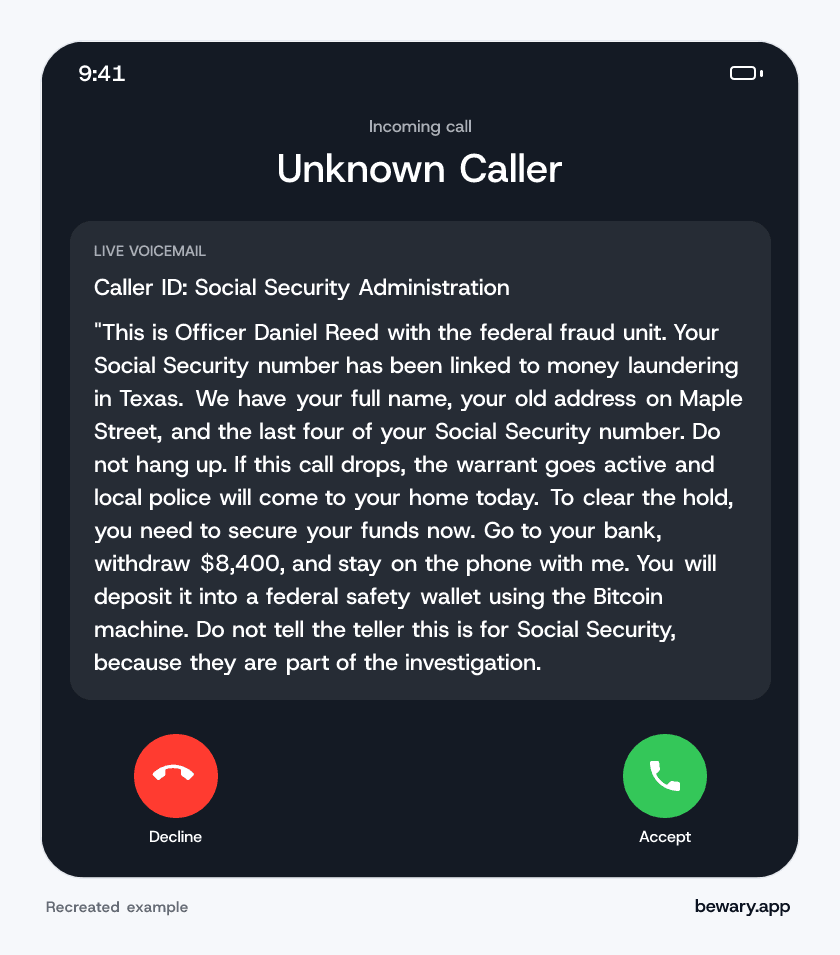
Yes, this is a scam if the caller threatens arrest or demands crypto, gift cards, a wire, or a safe account transfer.
Hang up and call a number from your card, statement, or the agency site you type yourself. If they fight that, the call is fake.
What to do now
-
Hang up now.
If you are in a bank lobby, parking lot, store aisle, or beside a Bitcoin ATM, stop there. Do not keep the call alive while you move money, because the caller is steering each step.
-
Use the number on your card or statement to call the real bank.
Tell the bank the caller threatened arrest, account seizure, or fraud charges and asked for a wire, cash withdrawal, crypto, gift cards, or a safe account transfer. That gives the bank the exact pattern to look for.
-
Open the bank app or site you already use and check alerts there.
Look for secure messages, card locks, pending wires, new payees, or password changes. Do not use a link, callback number, or text code from the caller to reach your account.
-
Call the named agency only from the contact page you type in yourself.
If the caller claimed to be Social Security, the IRS, the FTC, police, or a court, do not use the number on caller ID. A real agency can tell you if there is a real notice without keeping you trapped on that call.
-
Tell your bank fast if you sent a wire, debit transfer, or cash withdrawal.
Say it came from a spoofed government or bank threat call, and ask for the fraud team. For a wire, ask whether a recall or hold is still possible before the receiving bank releases the funds.
-
Call the gift card company or Bitcoin ATM operator if that is how you paid.
Give the card numbers, receipt time, store, ATM location, wallet address, and the phone number that called you. With gift cards, unused value may still be blocked if you move fast.
-
Report the call at ReportFraud.ftc.gov.
Use the impostor or phone scam path, then enter the caller ID name, the threat used, the payment method, and any wallet address or gift card brand. Also report it to the real bank or agency the caller named so they can flag the spoofed script.
How to spot this scam
Bewary's blocklist currently flags 16,373 phone numbers used in scam calls and texts. 14 of them are VoIP lines, the cheap numbers these campaigns burn through.
Bewary's own blocklist, as of November 26, 2026. This is what the list protects against, not a count of people targeted.
-
Hang up if the caller says a warrant starts unless you pay today.
Real warrants do not pause because you bought Bitcoin or moved cash. The fake officer uses the countdown to stop the one thing that breaks the script: you calling the real agency back.
-
Hang up if they send you to a Bitcoin ATM, gift card rack, or wire desk.
In this scam, the caller gives you a wallet QR code, a gift card brand, or wire details while claiming it is a bond, fine, or federal safety deposit. Once you read codes or scan the wallet, the caller has the money, not the government or bank.
-
Stop moving if they keep you on the phone while you drive, bank, or shop.
They want to hear the teller, the clerk, and your doubts in real time. You may hear lines like "say it is for home repairs" or "do not mention Social Security," because a normal employee would recognize the scam.
-
Do not trust caller ID, even when it shows your bank, SSA, IRS, or police.
Spoofing lets a scam call display a real name or number on your screen. Caller ID shows what the phone network was told to show, not who is standing behind the call.
-
Hang up if they say your money must go into a safe account.
Banks freeze fraud inside your account, replace cards, or open a claim. They do not protect your savings by making you wire it to a stranger, scan a crypto wallet, or withdraw cash for a courier.
-
Do not trust the call because they know your address or last four.
Old addresses, partial Social Security numbers, loan names, and bank names leak in breaches and data broker files. The caller reads those scraps like a case file so the threat feels official before the payment demand appears.
-
Hang up when a second agent or banker joins to confirm the story.
The handoff is staged to make you think three departments checked the same file. One person plays the investigator, another plays bank fraud, and a third may play local police so you stop asking why none of this is in writing.
-
Stop if they tell you to lie to a teller, clerk, or family member.
That order is not secrecy for an investigation. It is a way to get you past the exact people who have seen this script before, especially bank staff trained to stop cash withdrawals for impersonation calls.
-
Never read a one-time passcode to a caller who says they are protecting you.
Bank impostors use the threat call to make you panic while they try to enter your account. The passcode they ask you to read may approve a login, password reset, new payee, or transfer.
Got a call like this? Check the number free
Enter the number that called. Bewary checks FTC and FCC complaints and its scam lists, and gives you a straight answer and the reason why.
Sources and reporting
Use official channels to confirm a suspicious request and report fraud.
- Allstate Newsroom – Impersonation Scams Lead Top 2026 Scam Casesallstatenewsroom.com
- FTC – Government Impersonators Consumer Adviceconsumer.ftc.gov
- Bitdefender – Slam the Scam Day 2026bitdefender.com
- FTC Consumer Alert – Hang Up on Unexpected Calls Saying You Owe Back Taxesconsumer.ftc.gov