Why did MyCartSave text me? Is it legit?
MyCartSave: You left items in your Willow & Pine cart. Complete your $48.72 order before your items are released: https://mycartsave-checkout.com/willowpine/849217 Reply STOP to opt out.
Real service. Verify outside the text. The structural tell is the handoff: you dealt with a store, then a cart-recovery vendor you never chose sent the checkout link. MyCartSave says it helps merchants “recover abandoned carts” with automated texts, so the settling check is not tone or spelling. Open the retailer yourself and see whether the same cart exists there.
How to spot the MyCartSave scam
- The sender name is not the store.Why
- The phone-number path runs through checkout, not through a relationship with MyCartSave.Why
- The link is the thing to read, not the store name in the sentence.Why
- A MyCartSave redirect is believable because the real service sits between the store and the shopper.Why
- Vague cart details are a bad sign.Why
- The page asks for payment before proving the cart.Why
- The pressure is tied to cart abandonment.Why
- The STOP line does not authenticate the text.Why
- A real vendor can still deliver an unwanted text.Why
What to do now
- Do not tap first.Why
- Open the retailer yourself.Why
- If the cart is real but the text was not wanted, handle the opt-out from the verified path.Why
- If you already opened the link, stop at the address bar.Why
- If you typed payment details, check for a real order from the retailer first.Why
- Preserve the text, then use 7726.Why
- File the fraud report at ReportFraud.ftc.gov if the link was fake, asked for payment, or used a store name without a real cart.Why
What it looks like on your phone
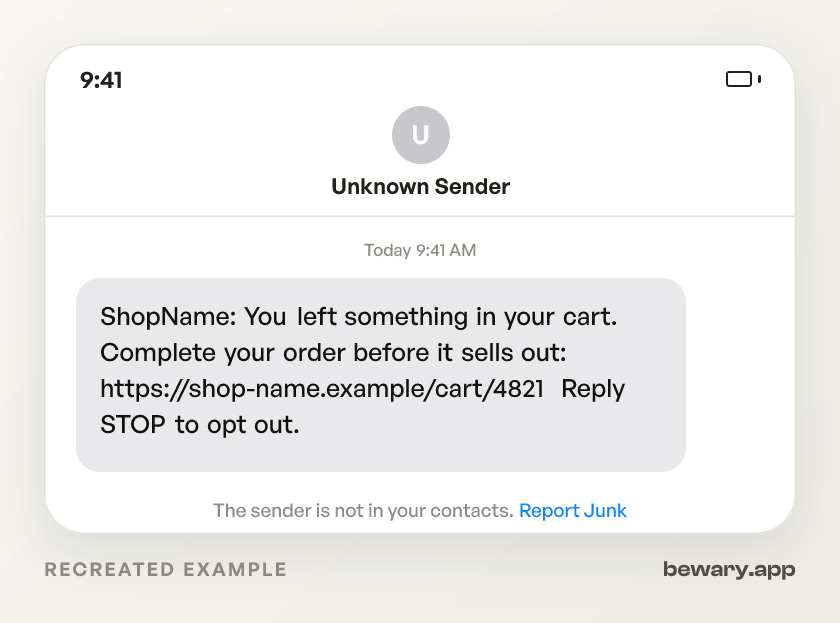
Got a message like this? Check yours free
Paste any text, link, or number you are unsure about. Bewary gives you a straight answer in seconds, and the exact reason why.
Private. Never sold, never tied to you.
The detail behind this
The reasoning behind each line above, for when the immediate question is settled.
Why each of those gives it away
The sender name is not the store.
That fits the real MyCartSave model, because the merchant can use a third-party SMS tool after you abandon checkout. It also gives a copycat cover, since an unfamiliar name on your phone is normal for this exact flow.
The phone-number path runs through checkout, not through a relationship with MyCartSave.
You type a number into a store form, the store can pass that number into an abandoned-cart text workflow, and the vendor sends the reminder. If the checkout page did not show a clear marketing-text consent box, the text can be real and still not something you agreed to receive.
The link is the thing to read, not the store name in the sentence.
On a phone, scammers count on you seeing “Willow & Pine” and missing the registered domain. In https://mycartsave.com.secure-cart.shop/willowpine, the real domain is secure-cart.shop, not mycartsave.com, because the controlling domain sits at the end of the host name before the first slash.
A MyCartSave redirect is believable because the real service sits between the store and the shopper.
That is the weak spot. A fake only has to copy the shape, a cart reminder, a retailer name, a tokenized path, and a STOP line, then send you to a payment page it controls.
Vague cart details are a bad sign.
A real abandoned-cart system is fed by the retailer’s cart session, so it should know the merchant and usually enough cart context to match what you actually left behind. A fake text leans on a loose store name, a dollar amount that does not match, or a bare “your items” line because it does not have the store’s cart data.
The page asks for payment before proving the cart.
MyCartSave’s role is the reminder and redirect, not a mystery checkout branded only around a recovery link. If the link opens a generic card form, or keeps you on a MyCartSave lookalike instead of the retailer’s normal checkout, the form can take the card number and billing address without placing any order with the store.
The pressure is tied to cart abandonment.
Lines like “items are released,” “inventory may sell out,” and “finish checkout” are built to turn a half-decision into a tap. That wording is not proof of fraud by itself, but it is a reason to slow down and verify through the retailer’s site instead of the text path.
The STOP line does not authenticate the text.
Real SMS marketing texts commonly include “Reply STOP to opt out,” and scammers include the same line because victims expect to see it. Treat STOP as an opt-out command only after you have confirmed the sender and link belong to the real cart-recovery flow, not as proof that the message is safe.
A real vendor can still deliver an unwanted text.
The fraud question and the consent question are separate. MyCartSave can be a real abandoned-cart service, while the store still failed to get clear permission to send marketing texts to the phone number you entered during checkout.
Working through the steps
Do not tap first.
Do not reply first. That prevents the tracking link from loading, keeps you off a possible lookalike checkout, and stops you from treating the text thread as trusted before you have checked the store.
Open the retailer yourself.
Type the store address into the browser, use the store app, or go through a bookmark, then sign in and look at your cart. If the same items and total are there, you can continue from inside the store’s own checkout. If no cart exists, treat the text as fake.
If the cart is real but the text was not wanted, handle the opt-out from the verified path.
Use the store account’s SMS or marketing settings if they exist, or reply STOP only after the sender and link match the legitimate MyCartSave flow. Send the screenshot to the store’s support team and ask where you consented to abandoned-cart texts.
If you already opened the link, stop at the address bar.
Read the host name before typing anything, and look for a registered domain such as mycartsave.com or the retailer’s real domain, not a longer host ending in something like secure-cart.shop or checkout-alerts.net. Closing the page at this point is enough if you did not enter payment or login details.
If you typed payment details, check for a real order from the retailer first.
No order in the retailer account means the card data likely went to the page, not the store. Call the card issuer using the number on the card, say the card was entered on a suspected fake abandoned-cart checkout, and ask what they can block or replace.
Preserve the text, then use 7726.
Screenshot the sender, date, full message, and the visible URL, then forward the suspicious SMS to 7726, the spam-reporting shortcode used by major US mobile carriers. If your carrier asks for the sender number, send that next. This gives the carrier the exact MyCartSave-style lure and sender to review.
File the fraud report at ReportFraud.ftc.gov if the link was fake, asked for payment, or used a store name without a real cart.
Paste the full text, the URL, the sender number, the retailer named, and whether you had recently entered your phone at that store. That creates a formal complaint tied to this specific abandoned-cart impersonation, not just a vague spam report.
Sources and reporting
Use official channels to confirm a suspicious request and report fraud.