Is the T-Mobile reward points text a scam?
T-MOBILE: Your 7,860 Magenta Reward Points expire at 11:59PM. Redeem now for a FREE iPhone 15 Pro. Pay $2.95 shipping only: https://claim.t-mobile-reward.vip/redeem Reply STOP to end
It is fake. The structural tell is the reward system itself: a text invents expiring T-Mobile points, then sends you outside T-Life to claim a phone. T-Mobile's real customer perks sit in the T-Life app, not in a midnight points balance sent to random SMS threads.
How to spot the T-Mobile scam
- Reject any text that says your T-Mobile points expire tonight.Why
- Leave any iPhone prize link outside T-Life unopened.Why
- Read the root domain immediately before the first slash.Why
- Walk away when the free phone needs shipping money.Why
- Close pages that ask for your T-Mobile ID after a texted prize.Why
- Treat group-message rewards as a bulk blast, not account service.Why
- Do not trust STOP in a fake prize blast.Why
- Treat brand mashups like Magenta Loyalty Points as evidence.Why
What to do now
- Leave the link closed and open T-Life.Why
- Forward the exact text to 7726.Why
- Block the sending number after the 7726 report.Why
- Change your T-Mobile ID password if you typed it.Why
- Turn on Account Takeover Protection for each line you own.Why
- Replace the card if you paid the fake shipping fee.Why
- Check your T-Mobile account for wireless changes, not points.Why
What it looks like on your phone
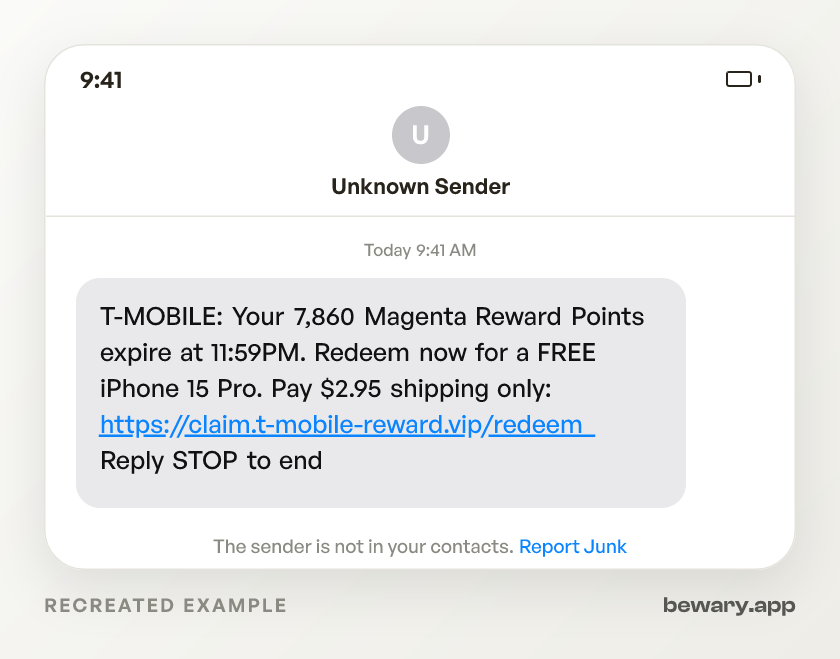
Got a message like this? Check yours free
Paste any text, link, or number you are unsure about. Bewary gives you a straight answer in seconds, and the exact reason why.
Private. Never sold, never tied to you.
The detail behind this
The reasoning behind each line above, for when the immediate question is settled.
Why each of those gives it away
Reject any text that says your T-Mobile points expire tonight.
T-Mobile does not run a general customer points balance that gets wiped at midnight by SMS. The scammer invents a number like 7,860 points because it feels pulled from your account, but the account feature behind it is fake.
Leave any iPhone prize link outside T-Life unopened.
The scam path is always the same: points, prize, checkout, then a tiny shipping charge. Real T-Mobile customer perks live in T-Life, while this lure sends you to a web page built only to collect logins and card data.
Read the root domain immediately before the first slash.
In a link like https://secure.t-mobile.com.reward-center.vip/claim, the root domain is reward-center.vip, not t-mobile.com. Scammers stack trusted words on the left because most people stop reading after they see T-Mobile near the front.
Walk away when the free phone needs shipping money.
The $1.95, $2.95, or $4.99 charge is not about postage. It proves the card works, captures the billing ZIP for card checks, and gives the fake checkout a reason to store the card for later charges labeled as handling, VIP access, or membership renewal.
Close pages that ask for your T-Mobile ID after a texted prize.
A T-Mobile ID is worth more than a fake iPhone form because it touches wireless lines, billing, device orders, and SIM or eSIM settings. The copied magenta buttons are there to make the login box feel routine before the prize page asks for payment.
Treat group-message rewards as a bulk blast, not account service.
Private account rewards do not arrive in a thread with ten random numbers from other area codes. That layout shows the sender blasted a list and hoped the group confusion would make victims think other T-Mobile customers got the same deal.
Do not trust STOP in a fake prize blast.
Scammers add STOP because real marketing texts use it, and it makes the message look regulated. In this setup it also gives them a clean signal that your number is alive and that a human is reading reward lures.
Treat brand mashups like Magenta Loyalty Points as evidence.
Scam kits rotate names such as T-MOBILE VIP, TMobile Reward Center, Magenta Points, and Loyalty Bonus because they are not tied to a real T-Mobile account product. The wording changes while the structure stays fixed: urgent points, prize link, shipping fee.
Working through the steps
Leave the link closed and open T-Life.
This settles the scam without giving the fake site your browser, location prompt, T-Mobile ID, or card. In T-Life, check for real offers, device orders, financing, SIM or eSIM changes, and account messages, not for the fake 7,860 points line.
Forward the exact text to 7726.
T-Mobile and other carriers use 7726, which spells SPAM on a phone keypad, for unwanted texts. Forwarding preserves the lure, the sender route, and the fake reward link; if the system asks for the sender, send the number or short code shown in the thread.
Block the sending number after the 7726 report.
Reporting first keeps the message content intact for the carrier route, then blocking cuts off the same sender. Expect follow-up bait such as payment declined, delivery failed, or last chance reward if the first text showed a live victim.
Change your T-Mobile ID password if you typed it.
Do it inside T-Life or your T-Mobile account, not through any texted page. That cuts off the stolen login before the scammer uses it to inspect lines, change contact details, start a device order, or set up another recovery path.
Turn on Account Takeover Protection for each line you own.
T-Mobile offers Account Takeover Protection to help stop unauthorized number transfers. Add it after a fake reward login hit, because a stolen wireless login and account details make port-out and SIM-swap attempts easier.
Replace the card if you paid the fake shipping fee.
Use your card issuer's app or its fraud support route and say the card was entered on a fake T-Mobile prize checkout for a small shipping charge. That blocks the stored card number before the same checkout token is reused for handling fees, subscriptions, or test charges.
Check your T-Mobile account for wireless changes, not points.
Look for new lines, device financing, SIM or eSIM swaps, plan changes, contact email changes, and autopay changes. The points were the cover story; after a login hit, the money is in phones, number control, and card charges.
Sources and reporting
Use official channels to confirm a suspicious request and report fraud.