Is this trapped inheritance fund email a scam?
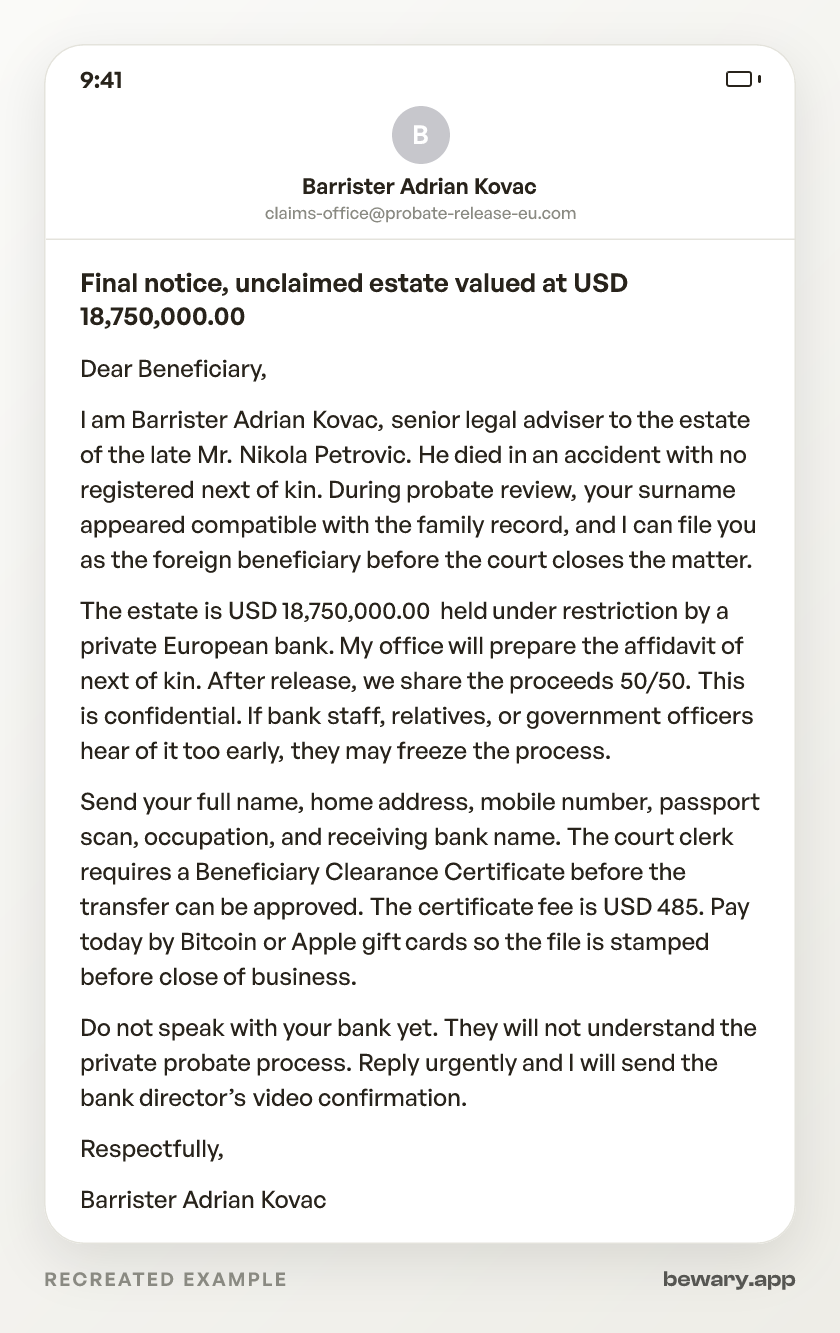
From: Barrister Adrian Kovac <claims-office@probate-release-eu.com> Subject: Final notice, unclaimed estate valued at USD 18,750,000.00 Dear Beneficiary, I am Barrister Adrian Kovac, senior legal adviser to the estate of the late Mr. Nikola Petrovic. He died in an accident with no registered next of kin. During probate review, your surname appeared compatible with the family record, and I can file you as the foreign beneficiary before the court closes the matter. The estate is USD 18,750,000.00 held under restriction by a private European bank. My office will prepare the affidavit of next of kin. After release, we share the proceeds 50/50. This is confidential. If bank staff, relatives, or government officers hear of it too early, they may freeze the process. Send your full name, home address, mobile number, passport scan, occupation, and receiving bank name. The court clerk requires a Beneficiary Clearance Certificate before the transfer can be approved. The certificate fee is USD 485. Pay today by Bitcoin or Apple gift cards so the file is stamped before close of business. Do not speak with your bank yet. They will not understand the private probate process. Reply urgently and I will send the bank director’s video confirmation. Respectfully, Barrister Adrian Kovac
Yes, it is advance-fee fraud. The structural tell is the role swap: a stranger makes you an heir, investor, diplomat, or next of kin, then makes you pay before any verified claim exists. An actual estate or court file can be checked through known public channels. This script gives you secrecy, a 50/50 split, and a made-up release fee instead.
How to spot this scam
- Reject any email that makes you an heir by surname match.Why
- Stop when the claim pays you only after you pay first.Why
- Do not buy a “Beneficiary Clearance Certificate” for a stranger’s estate.Why
- Refuse the 50/50 split on money you never owned.Why
- Keep your passport, address, and bank name out of the thread.Why
- Check the root domain after the @ sign before you believe the title.Why
- Treat “do not tell your bank” as an instruction to isolate you.Why
- Expect a new officer to appear after the first payment.Why
- Ignore videos, seals, bar cards, and bank letters unless the claim verifies outside the message.Why
What to do now
- Stop replying to the lawyer, bank officer, courier, and clerk accounts.Why
- Do not send the certificate fee, tax fee, release fee, or courier fee.Why
- Call your bank from its app, statement, or card if any bank payment left.Why
- Contact the exchange or gift card issuer if you paid by crypto or cards.Why
- Save the original email, not just screenshots.Why
- Report money loss to the FBI Internet Crime Complaint Center at ic3.gov.Why
- Warn your bank and accounts about identity exposure if you sent ID.Why
What it looks like on your phone
Got a message like this? Check yours free
Paste any text, link, or number you are unsure about. Bewary gives you a straight answer in seconds, and the exact reason why.
Private. Never sold, never tied to you.
The detail behind this
The reasoning behind each line above, for when the immediate question is settled.
Why each of those gives it away
Reject any email that makes you an heir by surname match.
The scammer needs a cheap reason to pull you into the story, so the message says your last name matches a dead person or an old account. That is not how probate finds beneficiaries. It is how a criminal turns a cold email into a personal hook.
Stop when the claim pays you only after you pay first.
The fake fund is always blocked by a certificate, tax stamp, court seal, anti-terror check, demurrage fee, transfer code, or diplomat charge. The name changes. The math does not. Your money leaves first, and the large balance stays behind a new obstacle.
Do not buy a “Beneficiary Clearance Certificate” for a stranger’s estate.
That phrase is built to sound official while staying vague enough to fit any country, bank, or court. The scammer can print it on a forged letterhead, then say the clerk, registrar, or bank director needs a separate payment to stamp it.
Refuse the 50/50 split on money you never owned.
The split is the bait, because it makes the crime feel like a clever opportunity instead of a theft. The sender is asking you to pretend to be next of kin, hide the plan, and route a bank transfer. That is not a windfall. It is the script that keeps you ashamed and quiet.
Keep your passport, address, and bank name out of the thread.
Those details let the scammer build a cleaner second act. They can forge forms in your name, try account recovery questions, open mule accounts, or come back as a fake investigator who already knows your document number and payment history.
Check the root domain after the @ sign before you believe the title.
A message can show “Probate Court Office” as the display name while the address ends in a bought domain such as probate-release-eu.com, claims-vault-gov.net, or a free mailbox. Read the part after the @, then the final root before the slash. That is where the lie usually sits.
Treat “do not tell your bank” as an instruction to isolate you.
The sender knows a bank employee will recognize the pattern in seconds: foreign estate, urgent release, fee before payout, secrecy. They are not protecting the file. They are removing the person who can stop the wire, card purchase, or crypto withdrawal.
Expect a new officer to appear after the first payment.
Once you pay the certificate fee, the “lawyer” may hand you to a bank director, customs officer, courier agent, tax controller, or anti-money-laundering unit. It feels like progress because the cast changes. It is one crew collecting more fees from the same mark.
Ignore videos, seals, bar cards, and bank letters unless the claim verifies outside the message.
Fraud kits include stamped PDFs, fake court receipts, copied lawyer photos, and video clips recorded by hired actors. None of that settles the structure. A secret inheritance that requires gift cards, crypto, or a private wallet payment is not a legal claim.
Working through the steps
Stop replying to the lawyer, bank officer, courier, and clerk accounts.
This cuts off the handoff chain. Advance-fee crews use multiple characters to make the file feel active, and every answer gives them a new angle: urgency, guilt, authority, or a fake deadline.
Do not send the certificate fee, tax fee, release fee, or courier fee.
If you already paid one charge, do not treat the next one as the finish line. The first payment proves you can be moved. The next message will say the transfer is approved but blocked by one last stamp.
Call your bank from its app, statement, or card if any bank payment left.
Ask for the fraud team, a wire recall, and a receiving-account freeze attempt. Give the beneficiary name, account number, amount, date, and every message that gave payment instructions. The point is to move before the receiving account empties.
Contact the exchange or gift card issuer if you paid by crypto or cards.
Give wallet addresses, transaction hashes, card numbers, redemption receipts, screenshots, and timestamps. Ask them to mark the wallet or card redemption as fraud and preserve records tied to the account that received the value.
Save the original email, not just screenshots.
Keep full headers, attachments, reply addresses, PDFs, wallet addresses, bank details, phone numbers, chat handles, and video-call links. Forwarded screenshots miss routing data. The original message can show the sending server, return path, and domain setup.
Report money loss to the FBI Internet Crime Complaint Center at ic3.gov.
Include the subject line, sender address, payment route, wallet or bank details, amount, and dates. IC3 is the FBI’s public reporting route for internet crime, and the payment identifiers matter more than the scammer’s fake name.
Warn your bank and accounts about identity exposure if you sent ID.
Ask your bank to add notes or extra verification on your profile, then change passwords on email and financial accounts that share recovery details. Watch for the follow-up hit: fake recovery agents, police, or lawyers claiming they can get the trapped money back for another fee.
Sources and reporting
Use official channels to confirm a suspicious request and report fraud.