Is the free ID verification site my dating match sent a scam?
Hey, I like talking to you lol. Can we move off here? The app is full of fake people and I got burned once. Before I meet anyone now I do a safe-date ID check. It’s free, it confirms you’re not on an offender list and that you’re over 18. They ask for a card to stop minors, no charge. I already did mine. Here’s the link: meetshield-verify.com/freecheck?id=41782. Send me the badge screenshot and I’ll send my number. Don’t make it weird, I’m trying to be safe ❤️
Yes. It is a rebilling trap. The tell is not the flirting style. It is the outside safety link. A real dating-app check happens in the app account flow. This one starts with a match demanding a third-party badge, then asking for name, email, phone, and card for a “free” offender or age check. The FBI has warned about fake dating verification sites built around that exact handoff.
How to spot this scam
- The verification starts with the match, not the dating app.Why
- The word “free” sits next to a card form.Why
- The page asks for the full bundle, not one narrow proof.Why
- The offender-list scare is doing sales work.Why
- The badge screenshot is part of the payment funnel.Why
- The subscription is hidden behind the verification story.Why
- The domain shape is disposable.Why
- The match withholds normal contact until the card page is done.Why
- The statement name may not match the badge site.Why
What to do now
- Save the evidence before the profile vanishes.Why
- Do not finish the badge flow.Why
- Report the profile inside the dating app as a fake safety or ID verification scam.Why
- If you entered a card, tell the issuer the exact mechanism: a dating match sent a fake free safety verification page that enrolled the card in recurring billing.Why
- Search your statement by behavior, not by the fake site name.Why
- Cancel only through a route you can document.Why
- Send the case to the FBI Internet Crime Complaint Center.Why
What it looks like on your phone
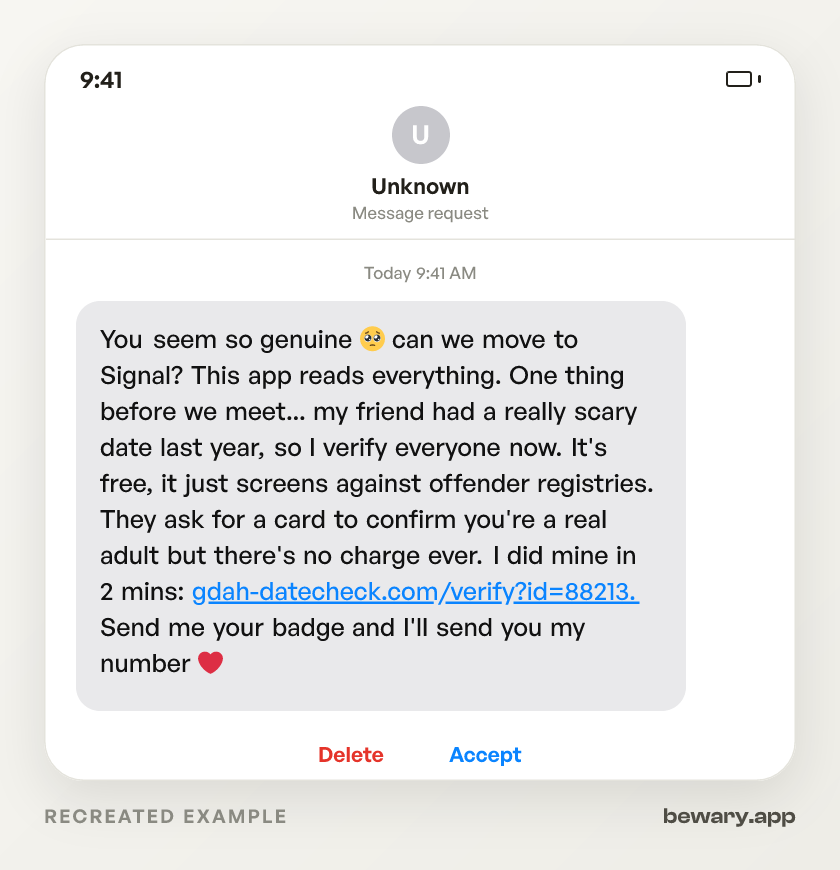
Got a message like this? Check yours free
Paste any text, link, or number you are unsure about. Bewary gives you a straight answer in seconds, and the exact reason why.
Private. Never sold, never tied to you.
The detail behind this
The reasoning behind each line above, for when the immediate question is settled.
Why each of those gives it away
The verification starts with the match, not the dating app.
That is the first hard tell. Real account checks are tied to your profile, your login session, and the app’s own settings. This script sends you outside that system, then makes a stranger the gatekeeper for whether you can get a phone number or a date.
The word “free” sits next to a card form.
That is the trap door. A card is not needed to prove you are not on an offender registry, and it does not prove you are over 18 in any reliable way. What it does well is create a card-on-file record that can be turned into a trial or monthly membership.
The page asks for the full bundle, not one narrow proof.
Name, email, phone, and card in one flow gives the operator billing access and a contact list for follow-up pressure. The FBI has described fake dating verification sites that collect personal and financial information under the cover of safety screening. That combination is the product.
The offender-list scare is doing sales work.
The scammer brings up assault headlines, sex offender checks, or “verified safe dater” badges right before the link because fear makes the card request feel reasonable. Public safety checking does not become more trustworthy because a flirting stranger says the site is safe. The scare keeps you from asking why the dating platform itself is not handling the check.
The badge screenshot is part of the payment funnel.
The match does not need the badge for safety. They need proof that you reached the checkout and gave the site what it wanted. A real dating profile verification would change something inside your account. This badge is a picture or landing-page result that can be demanded in chat and discarded when the fake profile gets reported.
The subscription is hidden behind the verification story.
These pages often present the card field as an age gate, then bury trial, membership, or partner-site language away from the main promise. After the first small authorization or “free” check, the billing can move under an adult, media, or dating membership name. You were sold safety. The charge is for entertainment access you never meant to buy.
The domain shape is disposable.
Look for dating or trust words glued to terms like verify, safe, guard, meet, check, ID, or badge, with the real root domain at the far end of the address. That shape lets the operator replace the site when banks, browsers, or victims start flagging it. The chat script stays the same. Only the link changes.
The match withholds normal contact until the card page is done.
“Send the badge and I’ll send my number” is not a safety boundary. It is a conversion step. The reward is always one step past the checkout: a phone number, a meet-up time, a private photo, or a move to another chat app. The promise keeps you paying attention to the person instead of the billing page.
The statement name may not match the badge site.
That matters in this scam because the lure is “verification,” while the billing often routes through unrelated membership processors or adult-content brands. Victims search their statement for the fake safety name and miss the recurring line. That delay gives the subscription more time to post again.
Working through the steps
Save the evidence before the profile vanishes.
Screenshot the profile, the chat where the badge is demanded, the link, the “free” claim, the card page, and any small-print membership language. Capture the handle and photos too. Fake dating profiles get deleted fast after reports, and the billing page may change once complaints start.
Do not finish the badge flow.
If you are sitting on the card page, leave it. If your bank sends a one-time code or purchase approval for the “free” check, do not approve it. That code can turn the fake verification into an authorized card-on-file charge, which makes the cleanup harder.
Report the profile inside the dating app as a fake safety or ID verification scam.
Attach the chat and link if the app allows it. Use the exact phrase the match used, such as safe-date ID, verified dater, offender check, or age verification badge. That helps the platform connect the account to other reports using the same script.
If you entered a card, tell the issuer the exact mechanism: a dating match sent a fake free safety verification page that enrolled the card in recurring billing.
Ask them to look for merchant-initiated subscription attempts tied to that checkout, not only a stolen-card purchase. Ask for the current merchant to be blocked and for any card-on-file token from that checkout to be shut down.
Search your statement by behavior, not by the fake site name.
Look for trial amounts, adult or dating membership names, media subscriptions, billing support labels, and repeat charges after the first small authorization. If the issuer can see the merchant category, descriptor, or processor notes, ask for those details. They help prove the safety-check story and the billing merchant do not match.
Cancel only through a route you can document.
If the billing page gives a cancellation form, screenshot each step, the confirmation, and the time. Do not give the operator more card details, a bank login, or a verification code to “process the refund.” A real cancellation does not need a fresh one-time bank code sent to your phone.
Send the case to the FBI Internet Crime Complaint Center.
Label it as a fake dating verification or safe-date ID scam. Include the dating app name, profile handle, chat screenshots, link, card descriptor, charge amount, and any phone or email follow-up the scammers used. That report gives investigators the pieces that connect one fake badge page to the larger network.
Sources and reporting
Use official channels to confirm a suspicious request and report fraud.